Search This Blog

THE MAGNIFICENCE OF AYAT-UL-KURSI

THE MAGNIFICENCE OF AYAT-UL-KURSI

 Read ONLY,  IF AND WHEN you have time and mood for: 
 “An Ayah of the Quran for 30 Days” -- November 2012


From the Pen and Perspective of a self-styled PPK Muslim (Proud, Practicing, Knowledgeable) with a humble submission that Islam totally rejects Blind Following BUT vigorously focusses on the Limitations of Pure Human Reasoning..............and clearly and comprehensively AlLAH knows best.

In the beginning of the seventh century C.E., the folks of Mecca and Medina had a fascinatingly unique window: they had direct access to the Heavens through one of their own. They were blessed with a regular stream of Divine counseling and guidelines. Question and answer sessions were part of the program. Even individual questioner was graced by an answer. In the short Introduction to this scheme they were assured that at the end of this twenty-two year project, Divine Directions and Admonitions will continue through the agency of the PEN. The whole discourse has been preserved and archived till eternity under the guarantee of our Lord and Creator. This record in known as the Quran. 

It should sound unbelievable but factually appears to be true: Many of our prevalent, widespread and important concepts and opinions about religious matters do not have a basis in the Quran and sometimes even appear to be in obvious conflict with the teachings of the Quran. It would be very educative and helpful to discuss an Ayah once a month to see if it supports or rejects our views and actions in our daily life. I wish and hope this email generates a fruitful interactive discussion. 


What follows is not a sermon; I do not feel qualified to give one, anyhow. I wish, it may provide some food for thought.

Surah Al-Baqaraa (2), Ayah 255
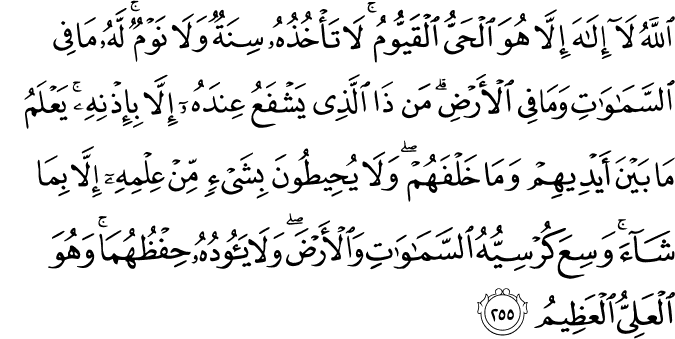
2:255

"Allah! There is no god but He,-the Living, the Self-subsisting, Eternal. No slumber can seize Him nor sleep. His are all things in the heavens and on earth. Who is there can intercede in His presence except as He permitteth? He knoweth what (appeareth to His creatures as) before or after or behind them. Nor shall they compass aught of His knowledge except as He willeth. His Throne doth extend over the heavens and the earth, and He feeleth no fatigue in guarding and preserving them for He is the Most High, the Supreme (in glory)". Yusuf Ali

Probably the only ayah in the Quran with a name, Ayatul Kursi describes the Oneness of Allah's being and attributes in a unique manner. It is very lovely and melodious ayah singing the glory and magnanimity of our Creator and the omnipresence and omnipotence of our Sustainer declaring that HIS sovereignty is unlimited and his power is absolute. This is the verse which the Messenger of Allah declared as the single greatest Verse in the entire Glorious Quran! It is very soothing to heart and very invigorating to the mind of a Muslim when he recites the ayah and understands it. As Allah says in Sura 29 ayah 45 “….and remembrance of Allah is the greatest (thing in life) without doubt….” Ayat ul Kursi, the famous and well known, one of the best, if not the best in the Quran is widely memorised and frequently displayed. It is a beautiful and effective description of the power of our Lord over the entire universe. It emphasis that Allah is the only deity, eternal, the protector and the cherisher for all mankind. HIS domain encompasses the whole universe, knower of all that exists in the worlds. No slumber ever touches HIM as fatigue is unknown to HIM. 

The Hadith literature is replete with the barakaat of reciting this Ayah. Ahaadith carry statements featuring its wonderful merits and blessings. It is strongly recommended to recite it after each prayer and at bed time. According to a hadith in al Nasa’i, the Holy Prophet said: If someone recites Ayah al Kursi after every fard salah, nothing stops him from entering Paradise except death. It is very comforting to do that. However it seems rather an exaggeration to prescribe it for so many specific situations. We must be extremely careful not to invent ourselves the rewards and the punishments of any act, unless one finds sufficient evidence for the same in the Glorious Quran or the authentic and established Sunnah of the Messenger of Allah. Also merely chanting it as a mantra for a particular purpose robs it of its beauty and its worth and value. One must get into the beauty of it rhythm and the depth of its meaning to enjoy it.  I am not sure of the numerous benefits of this great ayah for all sort of situations described in the hadith literature.1

“ Who is it that can intercede with Him except by His permission” declares Allah Ta’aala in this Ayah. Intercession is a highly controversial, confusing and variously defined concept amongst Muslims; the pendulum has a wide swing from it being an essential part of faith at one end to shirk and kufr at the other. The Quran has stated three different rulings on this practice on different occasions. 
First, it rejects the possibility of intercession altogether.2 
Second, it mentions this practice as a total prerogative of our Lord.3 
Lastly, the Qluran grants, as in this ayah that intercession will be allowed but ONLY after HE has given HIS permission.4

For reasons unknown, a strong segment of Islamic scholarship has relied on the third verdict and developed an important program of Intercession, strongly supported by the hadith literature. It appeals to many because it is practiced all the time in all walks of our worldly life. However it is emphasized even by the proponents that the interceder must have HIS permission; further this is not a general permission but only for a particular individual. It is conceded by the most ardent advocate that the scope for the benefit of intercession is very limited on the day of  judgement. Those who receive their account in the “left hand” will not qualify. Of those who receive it in their “right hand”, some may not need it in the first place. Some others with a great sin may be helped by intercession. 

Allah Ta’aala is All-Knowing, most gracious and merciful, cherisher and sustainer of mankind and The Most Judicious of Judges -- ahkami alhakimeen (95/8). I therefore, cannot not see here any room for intercession. Do you? Allah Ta’aala declares very clearly in Surah 50/16 “ wanahnu aqrabuilayhi min habli alwareed” -- and We are nearer to him than his jugular vein. Again I therefore, cannot see here any room for intercession. Do you? Lastly God Almighty assures us in Surah  2/186 “ Wa-itha saalaka AAibadeeAAannee fa-innee qareebun ojeebu daAAwata addaAAiitha daAAani” -- And when My servants ask you, [O Muhammad], concerning Me - indeed I am near. I respond to the invocation of the supplicant when he calls upon Me....... Here too, I cannot see any room for intercession. Do you? 

Dua and supplication is regarded as intercession. It is stated that Quran can intercede for you. Your goods deeds are considered as your intercessors. Who would disagree with any of these types of intercession?

The commentaries of some modern and renowned scholars on the ayahs of Intercession and the opinions of a few others are very educative and will help to confer some authority to my views.5

The ayah further declares “And they encompass nothing of His knowledge except what He wills.” This is to remind us that of the infinite and all encompassing knowledge of every particle in the universe of our Lord and Creator, we can only know what he desires. I would like to suggest a significantly practical meaning to this part of the verse. The word “AAilmihi” -- His Knowledge -- used in this part of the ayah obviously includes every branch of knowledge, religious and temporal. This concept of “deeni madaaris” -- religious schools -- is very misleading. Islam is all about performing in this “dunyaa” -- world -- to achieve your grades for the “deen” -- religion. To be a complete Muslim, Logic, Philosophy, Physics and Mathematics is as important as Fiqh and Hadith. You need college and university education to properly understand, really comprehend and correctly interpret the Holy Quran for the times we are living in. The vast knowledge and experience that we humans have acquired over the centuries and the explosion of information and learning that mankind has obtained and enjoy in our century is FROM HIM, with HIS permission and we have it because HE WISHED us to have it. We are therefore required to use ALL -- deeni and dunyawi -- this knowledges in the service of our religion: for its correct interpretation and propogation.  I must add however, I did not find any scholarly support for this view of mine in the commentaries I have consulted.

The assertion in this ayah “His Throne doth extend over the heavens and the earth”  has far and deep meaning to it, far beyond my ability to describe it. I have found the following explanations by two scholars very impressive:

Dr.Asad: "His seat [of power]". Some of the commentators (e.g., Zamakhshari) interpret this as "His sovereignty" or "His dominion", while others take it to mean "His knowledge" (see Muhammad 'Abduh in Manar III, 33); Razi inclines to the view that this word denotes God's majesty and indescribable eternal glory.

Yousuf Ali: Throne: seat, power, knowledge, symbol of authority. In our thoughts we exhaust everything when we say "the heavens and the earth". Well, then, in everything is the working of God’s power, and will, and authority. Everything of course includes spiritual things as well as things of sense.


.....and Allah knows best. 

May Allah Ta’aala bless us with true understanding--“fahm”--of our Deen, Aameen.


FOOTNOTES

[1]       
Fifteen Benefits of Ayatul Kursi: (As I have stated, I am not sure of all of these)
1. Our Holy prophet (SAW) has said: whoever recites the first 4 ayats 
of Surae Baqarah, then Ayatul Kursi and then the last 3 ayats of Surae Baqarah will not be inflicted with any kind of difficulty in his wealth or himself, Shaitaan will not come near him and he will not forget the Qur'an. 

2. Imam Ali (AS) was told by our Holy Prophet: Qur'an is a great word, and Surae Baqarah is the leader of the Qur'an and Ayatul Kursi is the leader of Surae Baqarah. In Ayatul Kursi there are 50 words and for each word there are 50 blessings and good in it. 

3. One who recites Ayatul Kursi every morning will be in the protection, safety of Allah until the night. 

4. If one ties this to ones wealth or chidren, they will be safe from Shaitaan. 

5. Our Holy Prophet (SAWW) has said: These things increase ones memory; sweets, meat of an animal near the neck, Adas(Lentils), cold bread 
and recitation of Ayatul Kursi. 

6. For those of our dear ones who have passed away, recitation of Ayatul Kursi and giving it as Hadiya to them, gives them light (noor) in the 
grave. 

7. Frequent recitation makes ones own death easy. 

8. When leaving home, if one recites it once, the Almighty has one group of Angels to come and protect you. If recited twice, 2 groups of 
Angels are assigned to do this. If recited 3 times Allah tells the Angels not to worry as the Almighty himself takes care of him. 

9. The Holy Prophet (saw) has said: If one recites Ayatul Kursi before going to sleep, Allah will send an Angel to come and look after you and protect you till the morning. His home, family and also neighbours will remain in safety until morning. 

10. When one is alone in the home, recitation of Ayatul Kursi and asking Allah to help will make you remain calm and you will not fear. 

11. The Holy Prophet has said: When leaving home,if one recites Ayatul Kursi the Allah will send 70,000 Angels to do Istighfaar for him until he returns home, and upon his return Poverty will be removed from him. 

12. If one recites this after doing Wudhoo, the 5th Imam (AS) has said: Allah will give him a reward of 40 years of Ibadaat, his position will be raised in the Heavens 40 times (levels) and will marry him to 40 Horains. 

13. One who recites it after every prayer, thier salaat will be accepted, they will remain in the safety of the Almighty and He will protect 
them. 

14. Allah (SWT) told P.Musa (AS): If one recites it after every salaat, the Almighty will make his heart a thankful one(Shakireen), will give him a 
reward of the prophets, and his deeds will be like those of the truthful(Siddiqeen) and nothing except death will stop will stop him from 
going into heaven. 

15. To increase light or vision (noor) in the eyes, recite Surae Alhamd once, then Ayatul Kursi and then once the following dua:- "U-eedhu nora 
basaree binuril lahi alladhi la yutfaa", "I seek refuge for the light of my eyes by the light of Allah(SWT), which does not become extinguished".
Compiled and researched upon by: 66Arifa Hudda

A few additional benefits have been reported:
1 When leaving home, if one recites it once, the Almighty has one group of Angels to come and protect you. If recited twice, 
2 groups of Angels are assigned to do this.If recited 
3 times Allah tells the Angels not to worry as the Almighty himself takes care of him. 
4.If one recites Ayatul Kursi before going to sleep, Allah will send an Angel to come and look after you and protect you until the morning.His home, family and neighbors will remain in safety until morning. 
5.If one recites this after doing Wudhoo, Allah will give him a reward of 40 years of Ibadaat, his position will be raised in the Heavens 40 times (levels) and will marry him to 40 Horains. 
6.One who recites it after every prayer, their salaat will accepted, they will remain in the safety of the Almighty and He will protect them. 
7. If one recites it after every salaat, the Almighty will make his heart a thankful one(Shakireen), will give him a reward of the prophets, and his deeds will be like those of the truthful(Siddiqeen) and nothing except death will stop will stop him from going into heaven...
[2] 
Surah 2/123

2:123

"And fear a Day when no soul will suffice for another soul at all, and no compensation will be accepted from it, nor will any intercession benefit it, nor will they be aided". Sahih International
Surah 2/254

2:254
"O you who have believed, spend from that which We have provided for you before there comes a Day in which there is no exchange and no friendship and no intercession. And the disbelievers - they are the wrongdoers".

[3]
Surah 32/4
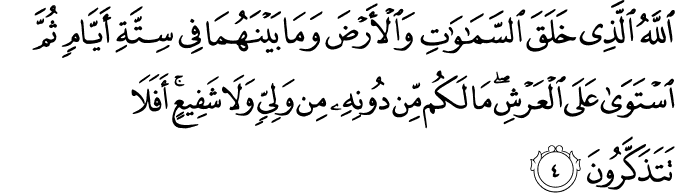
32:4
"It is Allah who created the heavens and the earth and whatever is between them in six days; then He established Himself above the Throne. You have not besides Him any protector or any intercessor; so will you not be reminded"? Sahih International

[4]
Surah 10/3
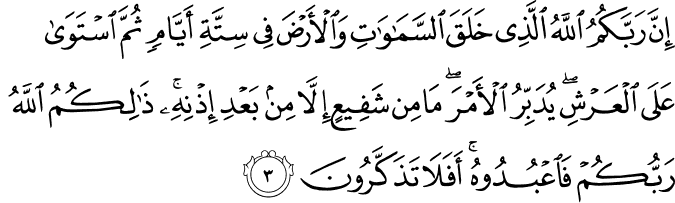
10:3
"Indeed, your Lord is Allah , who created the heavens and the earth in six days and then established Himself above the Throne, arranging the matter [of His creation]. There is no intercessor except after His permission. That is Allah , your Lord, so worship Him. Then will you not remember"?  Sahih International
Some additional ayahs on the same subject:
Surah  2/48 -- 2/255 -- 20/109 -- 21/28 -- 74/48 -- 10/3 -- 19/87 --345/23 -- 10/18 -- 11/105 -- 22/76 

[5]
Maudoodi: 
Not to speak of owning something, or being a partner in the ownership of something, or being a helper of Allah in any way, there exists no one in the universe, who of his own accord may intercede for someone before Allah. You are involved in the misunderstanding that there are some beloved ones of God, or some such powerful personalities, who can force and press God to accept their intercession, whereas the fact is that no one will dare utter a word of recommendation there without Allah's permission. Only such a one will be able to make his submissions, who is permitted by Allah to do so, and will intercede for him alone for whom permission for intercession is granted. (notes on Surah 34/23)

This refutes the wrong notion of those who are under the delusion that saints, angels, etc., wield great influence with Allah, and they will intercede with Him and force Him to pardon them. They are being warned that no creature of His can stand before Him and intercede for others, not to speak of forcing Allah to pardon them. No prophet, no angel, and no saint will dare utter a word without the permission of the Sovereign of the universe.

 "To speak": to intercede, and intercession has been made conditional upon two things:
(1) That the person who is granted permission by Allah to intercede for a sinner will alone be allowed to intercede and for the particular sinner only; and
 (2) that the intercessor will say only what is right and proper, and nothing derogatory,  and the one for whom he is interceding should have at least acknowledged the Truth in the world. That is, he should only be a sinner, not an unbeliever. 

This is a fine way of saying that no such intercessors exist as can plead their cases with Allah. For if "something" is not in the knowledge of Allah, it implies that it does not exist at all, for everything that exists anywhere in the heavens and the earth is in His knowledge. (n

The Qur'an employs this sentence to refute the creed of the mushriks in regard to intercession, as if to say, "You imagine that angels, prophets, saints,and the like can intercede with Allah on your behalf and therefore you worship them. You are absolutely wrong, for none of your deities knows what is good for you and what is not: Allah alone hears everything, sees everything and knows everything. Therefore He has not given the right of intercession and recommendation to anyone except when He Himself is pleased to give such permission. 

This is to warn these foolish people who depend on the promises of Their intercessors that they would protect them from the torment of the Day. They have been warned to desist from the evil deeds they are committing in the hope that their intercessors would not rest content till they succeed in obtaining from Allah permits of forgiveness for their sinful followers. This is because they believe them to be the beloved favorites of Allah Who cannot afford to displease them at any cost. Then they have been told that, not to speak of wielding any such influence, they shall not dare utter a word except with His permission. No saint, no angel, howsoever high, is so powerful or influential as to speak a word or make any recommendation in the Court of the Highest Sovereign unless He Himself permits it. Therefore such people as make offerings to others than Allah will be utterly disillusioned and disappointed on that Day, for they will come to know that they were foolish in relying on their intercessors and committing evil deeds in the world in the hope that they would deliver them from the torment of the Day. 

Yousuf Ali: 
After we realise that His Life is absolute Life, His Being is absolute Being, while others are contingent and evanescent, our ideas of heaven and earth vanish like shadows. What is behind that shadow is He. Such reality as our heavens and our earth possess is a reflection of His absolute Reality. The pantheist places the wrong accent when he says that everything is He. The truth is better expressed when we say that everything is His. How then can any creatures stand before Him as of right, and claim to intercede for a fellow-creature? In the first place both are His, and He cares as much for one as for the other. In the second place, they are both dependent on His will and command. But He in His Wisdom and Plan may grade His creatures and give one superiority over another. Then by His will and permission such a one may intercede or help according to the laws and duties laid on him. God’s knowledge is absolute, and is not conditioned by Time or Space. To us, His creatures, these conditions always apply. His knowledge and our knowledge are therefore in different categories, and our knowledge only gets some reflection of Reality when it accords with His Will and Plan. No one has the right to speak before the Judgment Seat; but certain great Dignitaries may be given permission to plead for mercy for sinners, and they will only so plead if the mercy is not negatory of God’s universal justice. 

For Shafa'ah (Intercession, Advocacy)  It follows that no one can intercede with God, except (1) by God’s permission, and (2) for those who have prepared themselves by penitence for God’s acceptance. Even in earthly Courts, Advocacy is not permitted to anyone; the Advocate must be granted the position of Advocate before he can plead before the judge. Nor can it be supposed that a plea for forgiveness or mercy can be put forward except on grounds recognised by equity and justice.

...... I have explained the two possible modes of interpretation. Each soul is individually and personally responsible. And if there is any intercession, it can only be by God’s gracious permission. For the Day of Judgment will be a terrible Day, or Day of Wrath (Dies irae) according to the Latin hymn, when the purest souls will be stupefied at the manifestation of God’s Power.

Dr. Asad: 
Literally, the translation is "the intercession of intercessors" - implying that there would be none to intercede for them with God. As regards the much-misunderstood Islamic concept of "intercession", - "there is none that could intercede with Him unless He grants His leave therefor".

 Literally "there is no intercessor whatever, save after His leave [has been granted]". Cf. 2:255 - "Who is there that could intercede with Him, unless it be by His leave?" Thus, the Qur'an rejects the popular belief in unqualified "intercession" by living or dead saints or prophets. As is shown elsewhere in the Qur'an (e.g., in 20:109, 21:28 or 34:23), God will grant to His prophets on Judgment Day the permission to "intercede", symbolically, for such of the sinners as will have already achieved His redemptive acceptance (rida') by virtue of their repentance or basic goodness (see 19:87 and the corresponding note 74): in other words, the right of "intercession" thus granted to the prophets will be but an expression of God's approval of the latter. Furthermore, the above denial of the possibility of unqualified intercession stresses, indirectly, not only God's omniscience - which requires no "mediator" - but also the immutability of His will: and thus it connects with the preceding mention of His almightiness. 

 According to the classical commentators - including some of the most outstanding Companions of the Prophet - the "bond with God" denotes, in this context, the realization of His oneness and uniqueness. Consequently, as pointed out by Razi, even great sinners may hope for God's forgiveness - symbolically expressed by the right of "intercession" which will be granted to the prophets on Judgment Day provided that, during their life on earth, they were aware of God's existence and oneness. 

 This relates not only to the worship of saints, angels and "deified" persons as such, but also to that of their symbolic representations (statues, pictures, relics, etc.) and, in the case of defunct human personalities, of their real or reputed tombs. Since all such practices are based on the worshipper's hope of "mediation" between himself and God, they obviously conflict with the concept of His omniscience and justice, and are, therefore - notwithstanding their widespread occurrence - utterly rejected by the Qur'an. 

Sheikh Muhammed Salih Al-Munajjid

Allaah did not accept the intercession of His Close Friend Ibraaheem for his father Azar who was a mushrik. It was narrated from Abu Hurayrah that the Prophet (peace and blessings of Allaah be upon him) said: “Ibraaheem will meet his father on the Day of Resurrection, and Azar’s face will be dark and covered with dust. Ibraaheem will say to him, ‘Did I not tell you not to disobey me?’ His father will say, ‘Today I will not disobey you.'’ Ibraaheem will say, ‘O Lord! You promised me not to disgrace me on the Day of Resurrection; and what will be more disgraceful to me than cursing and dishonoring my father?’ Then Allah will say, ‘I have forbidden Paradise to the disbelievers.’ Then he will be addressed, ‘O Ibraaheem, what is beneath your feet?’ He will look and there he will see a Dhabh (an animal,) blood-stained, which will be caught by the legs and thrown into the Fire.” (Narrated by al-Bukhaari, 3350).
The fact that the Prophet (peace and blessings of Allaah be upon him) and the believers will intercede does not justify asking them to intercede, as some people do when they ask the Prophet (peace and blessings of Allaah be upon him) to intercede for them even after his death.

Ibn Taymiyyah 
This topic is a foundational one as it relates to Tawhid, and from the above, it should be clear that intercession (shafaa’ah) belongs to Allaah alone, that He alone grants it, and that it should be asked only from Him alone, and that likening Allaah to the kings of the Earth as it relates to how intercession takes place with them, then that is a revilement upon Allaah, and anyone who believes that this is how Allaah operates with respect to His creation has committed kufr, for Allaah is free from all the deficiencies of created beings, lofty and exalted is He from all of that.

Jaafar Subhani: (Shia scholar and theologian, as quoted in Wikipedia)
Shia believe it is permissible to perform Tawassul through Muhammad, his family, the Prophets, and pious believers. This Shia scholar summarized the forms of intercession in Shia Islam as follows:
Intercession using the Quran: He backed this form of intercession using examples of supplications where believers ask Allah by the holiness of the Quran.
Intercession using righteous deeds: In this form, the believers ask Allah by the deeds they introduce in advance such as fasting or charity.
Intercession using the term "Oh Muhammad": That means believers address directly to the prophet by calling on his name so the prophet asks Allah on their behalf.
Intercession using the supplication of other believers: This is the most common form in which a believer may ask any other believer saying: please pray for me.

A few additional observations in Fiqh Jararia:
On that Day, no intercession shall avail, except the one from whom Allah, the Most Gracious has given permission and whose word is acceptable to Him.None shall have the power of intercession except one who has received permission or a promise from Allah, the Most Gracious.

According to these verses, certain people will have permission from Allah—such as prophets, imams, and awliya' (intimate friend of Allah)—to intercede and help people by the permission of Allah. Without His permission, no intercession will be accepted. Even during their lifetime, prophets had the ability to intercede on behalf of those who repented and sought forgiveness and returned to the path of Allah. The Quran states:
The Prophet Muhammad has also mentioned to the people in regards to his own intercession:
I will be interceding on the Day of Judgment for whoever has faith in his heart.
Each prophet before me asked Allah for something which he was granted, and I saved my request until the Day of Judgment for intercession on behalf of my nation.
My intercession will be for the people who committed the cardinal sins (al-kaba΄ir) except shirk and dhulm (polytheism and oppression).

The Intercessors are five: the Quran, one's near relatives, trusts (amanah), your Prophet, and the family of your Prophet (the Ahlul Bayt).

Shafa΄ah is not to ask the prophet or the imams for protection or to ward off calamity or to bring happiness and success. Rather, it is to plead to Allah, the Almighty by the sake of those who are near to Him, like the prophets and the imams.

As the Noble Quran asserts, only those who receive promise and permission from Allah can intercede and help people on the Day of Judgment. Intercession will be for those with good intentions and good belief in this life, who neither defied Allah nor challenged His authority but, perhaps fell behind in part of their religious obligations. Their good record will help them receive the intercession of the messengers, the imams, and the believers on the Day of Judgment.

Imam Ja'far al-Sadiq, the sixth Imam of the school of Ahlul Bayt, at the time of his martyrdom called his relatives and companions and said, “Verily, our intercession will never reach one who takes the prayers lightly.”


IS MUSLIM FIXATION ABOUT HOMOSEXUALITY SUPPORTED BY THE QURAN AND SHARI'AH

IS MUSLIM FIXATION ABOUT HOMOSEXUALITY 
SUPPORTED 
BY THE QURAN AND SHARI'AH        

 Read ONLY,  IF AND WHEN you have time and mood for: 
 “An Ayah for 30 Days” -- October 2012


From the Pen and Perspective of a self-styled PPK Muslim (Proud, Practicing, Knowledgeable) with a humble submission that Islam totally rejects Blind Following BUT vigorously focusses on the Limitations of Pure Human Reasoning..............and clearly and comprehensively AlLAH knows best.

In the beginning of the seventh century C.E., the folks of Mecca and Medina had a fascinatingly unique window: they had direct access to the Heavens through one of their own. They were blessed with a regular stream of Divine counseling and guidelines. Question and answer sessions were part of the program. Even individual questioner was graced by an answer. In the short Introduction to this scheme they were assured that at the end of this twenty-two year project, Divine Directions and Admonitions will continue through the agency of the PEN. The whole discourse has been preserved and archived till eternity under the guarantee of our Lord and Creator. This record in known as the Quran. 


It should sound unbelievable but factually appears to be true: Many of our prevalent, widespread and important concepts and opinions about religious matters do not have a basis in the Quran and sometimes even appear to be in obvious conflict with the teachings of the Quran. It would be very educative and helpful to discuss an Ayah once a month to see if it supports or rejects our views and actions in our daily life. I wish and hope this email generates a fruitful interactive discussion. 

What follows is not a sermon; I do not feel qualified to give one, anyhow. Hopefully, it will provide some food for thought.


Surah  Ash-Shu`arā' (26), Ayah 165-173
26:165
26:166
26:167
26:168
26:169
26:170
26:171
26:172
26:173


 “Do you go to the males from the creatures of the world, and leave that which your Lord has created for you in your wives? You have indeed transgressed all limits.” They said, “O Lot, if you do not desist from this, you will surely be included among those who have been expelled from our towns.” He said, “I am certainly one of those who abhor your wickedness. My Lord, deliver me and my people from their wicked deeds.”At last, We delivered him and all his people except an old woman who was of those who were left behind. Then We destroyed all the rest of them, and rained on them a horrible rain, which fell on those who had been warned".  Abul Ala Maudoodi:

Going in the reverse gear, let me start with my concluding remarks:
  • The Quran refers to homosexuality many times as the practice of People of Lot living in 2000 BC and squarely condemns it.
  • There is no direct commandment for Muslims about homosexuality.
  • There was no occasion for indictment or punishment for this vice during the life span of the Holy Prophet.
  • The Hadith literature is replete with very harsh punishment for this practice.
  • Hence most of us Muslims have grown up with an innate disgust for this practice.
  • There is no reliable and authentic scientific evidence to prove that homosexuality is a normal occurrence in the spectrum of human sexual orientation. If ever there is one, a Muslim is obliged to consider it.
  • It remains controversial, if this practice can be altered or “cured.”
  • It is a wrong approach to make homosexuality an issue of Human Rights or Individual freedom. It is a religious and philosophical problem for the civilised society. 
  • The attitude and response of the individual and society as a whole -- Muslim and non-Muslim -- to this problem seems to be complex, diverse and uncertain. 
  • ONE topic is CERTAIN, though. The LGBT should not be allowed to destroy the sacred, basic and fundamental Institution of Marriage recognised since known human history.
I am sorry; instead of “an ayah” I am discussing seven ayahs. This is the beauty of our Holy “Book.” A part of an ayah may mean volumes; on the other hand a group have to    be taken together to bring the full meaning out. The Quran is not a book as is commonly understood, with a narrative and a plot and divided into chapters and separate headings. It is a message from and a conversation with our Creator. 

I have included here five other references to homosexuality in the Quran comprising additional twenty-six ayahs.1 

All these thirty-three ayahs are about “people of Lot" also known as the people of Sodom and Gomarrah. These cities are mentioned in the Book of Genesis, the Hebrew Bible and the New Testament besides the Quran. These cities, were situated on the Jordan River plain in the southern region of the land of Canaan. The Jordan River plain (which corresponds to area just north of the modern day Dead Sea) has been compared to the garden of Eden in Genesis, being a land well-watered and green, suitable for grazing livestock. Sodom and Gomorrah have become synonymous with impenitent sin, and their fall with a proverbial manifestation of God's wrath. The name of these cities  have been used as metaphors for vice and homosexuality, viewed as a deviation. The story has created the English word sodom; even the Arabic words for homosexual behaviour (liwat) and for a person who performs such acts (luti) both derive from this name.

Prophet Lot was the nephew of Prophet Abraham. He lived in Iraq along with his uncle and traveled with him over Syria, Palestine and Egypt to gain experience for the propagation of the Message. Then he was appointed as a Messenger by Allah and sent to reform the wicked tribe, which has been called `his people' because he might have had some blood relation with it.

In these ayahs the Quran denounces the act of homosexuality clearly and forcefully as an heinous act in a people living in 2000 BC and were under the Shari’ah of Prophet Ibrahim/Lot. The Quran has condemned this act in strong words as: 
transgressed all limits 
wicked deeds 
shameless indecent acts as no one committed before you in the world evil indecent deeds
wicked, perverse and disobedient
steeped in ignorance
mischief makers and very wicked. 
Two additional criminal acts of these people are referred to as “commit robbery and indulge in indecencies.” Divine judgement was therefore passed upon them and they were completely consumed by fire and brimstone; and their destruction by Allah is associated explicitly with their sexual practices. 

It is noteworthy that all the references to this act in the Quran -- and there are many of them -- are related to the People of Lot. The Quran does not mention any clear commandment on this subject for the Muslims under Shari’ah-e-Mohammadi. The renowned scholar Maudoodi states in his Tafheem ul Quran “ Here and at other places the Qur'an merely declares that sodomy is such a heinous sin that it brought the wrath of Allah on a people.” However two minor evidence  in the Quran which could be regarded as relevant to our times.2

We therefore have to turn over to the second source of our Shari’ah -- the practice and preaching of our Holy Prophet -- for the the Islamic opinion on homosexuality. According to one source the Prophet took a lenient attitude toward sex between males. The Prophet viewed this vice with a philosophic indifference. Not only is the punishment not indicated -- it was probably some public reproach or insult of a slight nature -- but mere penitence sufficed to escape the punishment. Maudoodi confirms this when he declares “But no definite and specific punishment was prescribed for the criminals because during his time, no case of sodomy was ever brought before the Holy Prophet.”  Mohamed El-Moctar El-Shinqiti, a contemporary Mauritanian scholar, has argued that "(even though) homosexuality is a grievous sin
a) no legal punishment is stated in the Qur'an for homosexuality
b) it is not reported that Prophet Muhammad has punished somebody for committing homosexuality
c) there is no authentic hadith reported from the Prophet prescribing a punishment for the homosexuals.
However Sheikh Muhammed Salih Al-Munajjid of Saudi Arabia quotes the Prophet of Islam (peace and blessings of Allaah be upon him) as saying: "Whoever you find committing the sin of the people of Lut (Lot), kill them, both the one who does it and the one to whom it is done" - i.e. if it is done with consent. (This hadeeth was narrated by al-Tirmidhi in his Sunan, 1376).” However it is generally agreed that there is no authentic hadith reported from the Prophet prescribing a punishment for the homosexuals. Hadith scholars such as Al-Bukhari, Yahya ibn Ma`in, An-Nasa'i, Ibn Hazm, Al-Tirmidhi, and others have impugned them. Bakr Al-Jassas (d. 981 AD/370 AH) argued that the two hadiths on killing homosexuals "are not reliable by any means and no legal punishment can be prescribed based on them."

The four schools of Shari’ah (Islamic law) disagreed on what punishment is appropriate for homosexuality. Many scholars of Islamic law, interpret homosexual activity as a punishable offense as well as a sin. There is no specific punishment prescribed, however, and this is usually left to the discretion of the local authorities on Islam. The Hanafi school held that it does not merit any physical punishment; the culprit should be punished according to the circumstances of the crime with an exemplary punishment. There is also a saying of Imam Shafi`i to this effect. As against this the Hanbali school held that sodomy is a form of adultery and must incur the same penalty, 

 I grew up with an innate disgust and revulsion for homosexuality without ever thinking about about it. I am sure most of you feel the same because homosexuality is almost universally regarded by Muslims as:
shameless, wicked and immoral
filthy and detestable 
an evil and immoral deviation of man
neither natural nor a disease but a deviation of one's nature
an absolute abomination in the Sight of the Creator
stands for all  the perversions
a depravity of depravities
absolutely forbidden in Islam
an abomination and a grave sin
deserving death in the life of this world and eternal punishment in the Hereafter. 
Why? Why this almost consensus on it? I think this is because the hadith literature, which for most of us is the only source of religious knowledge is full of most severe and extra ordinary punishments for it: 
Hadrat 'Ali believed that the criminals should be killed with sword and the dead bodies should not be buried but burnt to ashes. 
Hadrat Abu Bakr also agreed with it. 
Hadrat `Umar and Hadrat `Uthman thought that they should be taken under the roof of a dilapidated building, which should be pulled down on them. 
lbn `Abbas has decreed that they should be thrown down headlong from the top of the highest building of the habitation and then stoned to death. Imam Shafi`i says that both the criminals involved in sodomy should be killed, whether married or unmarried. 
According to Shi`ibi" Zuhri, Malik and Ahmad they should be stoned to death. 
Said bin Musayyib, 'Ata, Hasan Basri, Ibrahim Nakh`i, Sufyan Thauri and Auza`i are of the opinion that the punishment is the same as for adultery, that is, one hundred stripes and exile for the unmarried, and stoning to death for the married. The description until now is a good example of the not infrequently seen total disconnect between the teachings of the Quran and the practice of our beloved Prophet on the one hand and the writings in the Hadith literature on the other. 

What are the facts on the ground about homosexuality? How common is it? Hard to say.  There are not many statistics out there. I am indebted to Wikipedia for the following information. In the US, the LGBT sources claim it to be 10%. Other sources put it at about 2.8% or between 1.3 % to 4%. I do not think there are figures available for Muslim Countries. It would be a fair assumption that it is not insignificant. There are reasons for that.  A strong emphasis on male virility leads adolescent males and unmarried young men to seek sexual outlets with boys younger than themselves. It is regarded as a temptation and to some anal intercourse is not seen as repulsively unnatural so much as dangerously attractive. Not all sodomy is homosexual: one Moroccan sociologist, in a study of sex education in his native country, notes that for many young men heterosexual sodomy is considered better than vaginal penetration, and female prostitutes likewise report the demand for anal penetration from their (male) clients. In Afghanistan though illegal, there was a tradition of such relationships in the country, known as "bache bazi" or boy play, and that it was especially strong around Kandahar. Raphael Patai in The Arab Mind, has argued that among some Arabs and Turks homosexuality can be justified as an expression of power. The active homosexual act is considered as an assertion of one’s aggressive  masculine superiority.

I was surprised to find that there are some LGBT movements in Islam as well. The Al-Fatiha Foundation is an organization which advances the cause of gay, lesbian, and transgender Muslims. It was founded in 1998 by Faisal Alam, a Pakistani American, and is registered as a nonprofit organization in the United States.The Foundation accepts and considers homosexuality as natural, either regarding Qur'anic verses as obsolete in the context of modern society, or stating that the Qu'ran speaks out against homosexual lust and is silent on homosexual love.  Al-Fatiha has fourteen chapters in the United States, as well as offices in England, Canada, Spain, Turkey, and South Africa. In addition, Imaan, a social support group for Muslim LGBT people and their families, exists in the UK. Both of these groups were founded by gay Pakistani activists. The UK also has the Safra Project for women (WikipediA).

The legal status of homosexuality in the Muslim World is variable. The death penalty is currently in place in Saudi Arabia, Iran, Mauritania, northern Nigeria, Sudan, and Yemen. In Saudi Arabia, while the maximum punishment for homosexual acts is public execution, the government will generally use lesser punishments e.g. fines, jail time, and whipping. Iran is perhaps the nation to execute the largest number of its citizens for homosexual acts. Since the 1979 Islamic revolution, the Iranian government has executed more than 4,000 such people. The Taliban enforced the death penalty in Afghanistan. The legal situation in the United Arab Emirates is unclear. In many Muslim nations, such as Bahrain, Qatar, Algeria, Uzbekistan and the Maldives, homosexuality is punished with jail time, fines, or corporal punishment. In Egypt, openly gay men have been prosecuted under general public morality laws. On the other hand, homosexuality, while not legal, is tolerated to some extent in Lebanon. In some Muslim-majority nations, such as Albania, Turkey, Jordan, Indonesia or Mali, same-sex intercourse is not forbidden by law, and in Albania there has been discussions of legalizing same-sex marriage. Lebanon also is considering to legalize homosexuality. 

It seems, despite the legal strictures on homosexual activity, the positive expression of male homeoerotic sentiment in Muslim literature was accepted, and probably assiduously cultivated, from the late eighth century until modern times. First in Arabic, but later also in Persian, Turkish and Urdu, love poetry by men about boys more than competed with that about women. Anecdotal literature reinforces this impression of general societal acceptance of the public celebration of male-male love.

 Most international human rights organizations, such as Human Rights Watch and Amnesty International, condemn laws that make homosexual relations between consenting adults a crime. Since 1994, the United Nations Human Rights Committee has also ruled that such laws violate the right to privacy guaranteed in the Universal Declaration of Human Rights and the International Covenant on Civil and Political Rights. Homosexuality is forcefully promoted as a human rights or individual freedom issue with very frightening and deleterious effects on the sacred and honorable Institution of Marriage. Marriage is strongly recommended in our Deen. Based on physiological, anatomical, emotional, psychological, social and religious grounds it is fundamentally a heterosexual union. It is imperative for continuation of the human species. It is the natural foundation for the formation of the family which is the UNIT of our civilised society. The newborn has the fundamental and basic right to have a biological father and a biological mother to ensure a healthy and robust development. Marriage, in its age old definition  should be preserved and protected at all costs. 

The modern “liberal” thinking  views homosexuality as normal and natural sexual orientation for a minority of adults. It is stated as a proof that children who will grow up to be gay can generally be detected before the age of five.  Neurological and neuroanatomical changes have been reported in the brains of homosexuals. There is reportedly evidence of a genetic basis. There is however no convincing evidence to support it. On the other hand there are similar and definite evidences to prove that diseases like Schizophrenia, Autism and Psychopathic behavior are also genetic. On the basis of the theory of neuroplasticity the changes seen in the brans of homosexuals may be consequential rather than causative. As a Muslim I do feel that my religious beliefs cannot and should not be contrary to proven scientific truths and modern knowledge delivered to mankind through the agency of the “PEN” which Allah Ta’aala has promised in the second part of the VERY FIRST Wahee. (Surah 96 Ayah 3-5)
96:3
Recite, and your Lord is the most Generous 
96:4
Who taught by the PEN
96:5
Taught man that which he knew not.  (Sahih International)

Bari Ta’aala had decided that the direct communication by revelation will be discontinued after twenty-two years and PERMANENTLY so that our Holy Prophet is the LAST in the series. The Cherisher and Sustainer of the Worlds  has therefore assured mankind in the first Wahee that thereafter he will be guided and taught by his Lord -- Rub -- till the Day of Judgement by the “PEN”. We, the Muslims wielded this Pen for seven centuries and reigned as the Torch Bearers of Civilization. Later we slumped into intellectual stagnation so the PEN was taken over by the non-Muslims who are now the source of all knowledge and progress. We seem to be so fossilized that we have even lost the realisation that Revelation has ceased with the demise of our Holy Prophet but the ever-lasting medium of Directions and Guidance by the “PEN” for  knowledge and progress from our Allah Ta’aala Subhanahoo has not. However there is no reliable or authentic evidence to suggest that homosexuality is different but a normal phenomena. So, for us it remains a deviation if not a perversion. If, say in the next century there is incontrovertible evidence to this effect then Muslims will have to revisit the ayahs of the Quran for fresh guidance.  

Finally, to the real issue: As a Muslim how do I deal with homosexuality and homosexuals in my social circle or, God forbid in my family? What do I advise if one looks up to me for help? Is there a “cure” for them. Frankly speaking, I am confused. “Don’t ask, Don’t tell” seems to be the path of least resistance available.  I have collected some current opinions on this problem. Perhaps this my help you and me to form an opinion.3

To repeat the conclusions, I started with:
  • The Quran refers to homosexuality many times as the practice of People of Lot living in 2000 BC and squarely condemns it.
  • There is no direct commandment for Muslims about homosexuality.
  • There was no occasion for indictment or punishment for this vice during the life span of the Holy Prophet.
  • The Hadith literature is replete with very harsh punishment for this practice.
  • Hence most of us Muslims have grown up with an innate disgust for this practice.
  • There is no reliable and authentic scientific evidence to prove that homosexuality is a normal occurrence in the spectrum of human sexual orientation. If ever there is one, a Muslim is obliged to consider it.
  • It remains controversial, if this practice can be altered or “cured.”
  • It is a wrong approach to make homosexuality an issue of Human Rights or Individual freedom. It is a religious and philosophical problem for the civilised society. 
  • The attitude and response of the individual and society as a whole -- Muslim and non-Muslim -- to this problem seems to be complex, diverse and uncertain. 
  • ONE topic is CERTAIN, though. The LGBT should not be allowed to destroy the sacred, basic and fundamental Institution of Marriage recognised since known human history.

.....and Allah knows best. 

May Allah Ta’aala bless us with true understanding--“fahm”--of our Deen, Aameen.


FOOTNOTES

[1] 
Surah 7/80-84
7:80
7:81
7:82
7:83
7:84

"And We sent Lot as a Messenger: Remember that he said to his people, "Have you become so shameless that you commit such indecent acts as no one committed before you in the world? You gratify your lust with men instead of women: indeed you are a people who are transgressors of all limits!" But the only answer of his people was no other than to say, "Turn out these people of your habitations for they pose to be very pious." At last We delivered Lot and the members of his household-except his wife, who was of those who stayed ' behind and We rained a rain upon his people then behold what happened in the end to the guilty ones."

Surah 11/77-83
11:77
11:78
11:79
11:80
11:81
11:82
11:83

" And when Our Messengers came to Lot, he was greatly perturbed and distressed in mind because of their visit and said, "This is a day of woe!" (No sooner did the visitors come to him than) his people spontaneously rushed towards his house, for they had previously been addicted to wicked deeds. Lot said to them, "O my people, here are my daughters, who are purer for you. So fear God and don't degrade me by committing evil to my guests. what ! Is there not a single good man among you ?" They replied, "You know it well that we have no need of your daughters, and you also know what we want. " Lot cried, "I wish I had the power to set you right or I could find some strong support for refuge."  Then the angels said, "O Lot, We are messengers sent by your Lord. They shall not be able to do you any harm. So depart from here with the people of your household in the last hours of the night. And look here: none of you should turn round to look behind; but your wife (who will not accompany you) shall meet with the same doom as they. The morning has been appointed for their destruction-the morning has almost come." Accordingly, when the time of the execution of judgment came, We turned the habitation upside down and rained on it stones of baked clay, and each one of these stones had been specifically marked by your Lord. And such scourge is not far from the workers of iniquity."

Surah 21/74
21:74

"And We bestowed judgment and knowledge on Lot, and delivered him from that habitation which committed indecent deeds. Indeed, they were a very wicked, perverse and disobedient people".

Surah 27/54-58
27:54
27:55
27:56
27:57
27:58

"And We sent Lot. Remember the time when he said to his people, "Do you commit indecency while you see it? Do you leave women and seek men for the gratification of your sexual desire? The fact is that you are a people steeped in ignorance."But the only reply his people gave was to say, "Expel the family of Lot from your habitation: they pose to be very pious." At last We saved him and his family except his wife about whom We had decreed that she would linger behind, and rained on then a rain, an extremely evil rain for the people who had been warned".

Surah 29/28-35
29:28
29:29
29:30
29:31
29:32
29:33
29:34
29:35


"And We sent Lot when he said to his people, "You commit the indecency which no other people has ever committed before you in the world. What! Do you go to the males, and commit robbery and indulge in indecencies in your assemblies?" Then the only answer his people gave was to say, "Bring forth the torment of Allah if you are truthful." Lot said, "O my Lord, help me against these mischief makers."  And when Our messengers came to Abraham with the good news, they said to him, "We are going to destroy the people of this habitation, for its people have become very wicked." Abraham said, "Lot is there." They replied, "We know full well who is in it we shall save him and all his household except his wife." His wife was of those who remained behind. And when Our messengers came to Lot, he was distressed for them and felt for them great discomfort. They said, "Fear not, nor grieve. Indeed, we will save you and your family, except your wife; she is to be of those who remain behind. Indeed, we will bring down on the people of this city punishment from the sky because they have been defiantly disobedient."And We have certainly left of it a sign as clear evidence for a people who use reason".

(2) 
     First, one of the ayahs quoted above (11/83) says “And they (the punishments) are never far from the wrongdoers”. This could be construed as a warning to us of the same fate if we commit the similar crime. 
     Second. there is a minority translation of ayahs 4/15-16 which is relevant to the issue under discussion:
4:15
4:16

" If any of your women be guilty of indecency, call for four witnesses from among yourselves to testify against them: If they give evidence and prove the guilt, then confine them to their houses until death comes to them or Allah opens some other way out for them. And punish the two of you who commit this crime; then if they both repent and reform themselves, leave them alone,for Allah is generous in accepting repentance, and merciful in forgiving sins".

 Abdullah Yousuf Ali comments on the words in Ayah 15 “if any of your women” as: “Most commentators understand this to refer to adultery or fornication: in that case they consider that the punishment was altered to 100 stripes by the later verse, 24:2. But I think it refers to unnatural crime between women, analogous to unnatural crime between men in 4:16 below”.  However in ayah 16 also he is the only one who translate as “two men”. The other mufesserins like Sahih International, Muhsin Khan, Pickthal, Shakir and Dr. Gali translate the relevant words as “the two” or “two persons”. Maudoodi clearly states: “Likewise, the commentary of Abu Muslim Isfahani that verse 15 is about the un-natural crime between two females and verse I6 about the un-natural crime between two males is also wrong. The Qur'an is concerned only with the fundamental principles of law and morality: therefore it only discusses those problems which are confronted in normal life and does not concern itself with the ones that are met with under abnormal circumstances. These latter problems, as they arise, are left for the people to decide according to their insight. That is why, when after the death of the Holy Prophet the case of unnatural crime between two males was brought before the Companions, none of them turned to these verses for its decision.” 

(3) 
(a) Yasir Qadhi has this to say:  Rather, what we can say to those who feel attracted to the same gender is that having such urges and conquering them is a part of the test Allāh has given them.......as long as the desire remains in the realm of feeling, you are not accountable on the Day of Judgment, but the second that this desire is manifested in a physical action, you are liable for all that follows....lastly, even if you have acted upon this urge – and we seek Allāh's refuge from this – know that this would constitute a sin. Yes, a major sin, and one that most people would be disgusted by, but realize that it is a sin alone and not a kufr. Hence, even acting upon it and committing a major sin does not expel you from the fold of Islam. However, to stand up and justify it, or defend it, or write articles claiming that it is Islamic, without a doubt constitutes a kufr, and not merely sin.....try to repel these urges, do not act upon them, take immediate steps to get married, and throughout all of this, put your trust in Allāh and continue making du‘ā’ to Him, and I pray that Allāh makes your situation easy for you and blesses you in this life and the next.
(b) This is an advise that a scholar gives to  a gay person who feels guilty, tries prayers and dua, got married but could not perform: “Respected brother, the things that will indeed help you stop your immoral and unlawful deviation is first and foremost the seeking of sincere 'taubah' and repentance from your Lord for your past transgressions, and the development of 'taqwa' or constant God-consiousness.” This advice to “dear and beloved” brother is followed by a list of relevant ayahs and hadiths. 

(c) Michael Muhammed, novelist, journalist, performance artist is also an author and commands great respect for his religious views. His remarks are quite interesting and a little confusing: “Muslims who think that a shared Abrahamic morality makes them more American are missing something big: the defining “culture war” of this moment is not Queer vs. Straight, Islam vs. the West, or Christians vs. Non-Christians: it is Tolerance vs. Intolerance, Equality vs. Inequality. In this war, as Intolerance pulls out its hair with panic and issues the same irrational screams about Muslims and Queers (They’re imposing their ways on us! They’re taking over! They’re destroying America!), the overturning of Prop 8 and the apparent triumph of the Cordoba House are victories for the same side. For Muslims who oppose same-sex marriage on religious and moral grounds: stay true to yourselves. Teach your values to your children. Pour your opinions into books and hand them out on street corners. Establish mosques in which homosexuality is denounced every Friday afternoon; but do so with the knowledge that in our real culture war, there are all kinds of people who will defend your place in American life. This includes not only a wide spectrum of Muslims, but also non-Muslims: Christians, Jews, Hindus, atheists, secular humanists, feminists, and homosexuals. Yes, the American Muslim community has gay friends. There are homosexuals who will stand with Muslims and support a religion that, at least in popular interpretations, condemns them to the point of capital punishment and otherworldly hellfire. In the name of upholding one aspect of Islamic tradition, however, some of us will refuse to return the favor. We will ask to be treated as equals by those who are different from us, but turn our backs when they ask the same.”

(d) Sheikh Muhammed Salih Al-Munajjid was asked: Can those who have committed homosexual acts be forgiven, and is it permissible for such a person to get married? 
He answered first referring to Shaykh al-Islam Ibn Taymiyah who was once asked  “but if the person who does this evil deed, or any other action which is subject to a hadd punishment, repents, gives up that sin, seeks forgiveness, regrets what he has done and intends never to go back to it”. He had responded “If he truly repents to Allaah, Allaah will accept his repentance, and he does not need to confess his sin to anyone so that the hadd punishment would be carried out on him.” (Majmoo’ al-Fataawaa, part 34, p. 180).
The Shaykh  then quotes an ayah: “And those who invoke not any other ilaah (god) along with Allaah, nor kill such person as Allaah has forbidden, except for just cause, nor commit illegal sexual intercourse; and whoever does this shall receive the punishment. The torment will be doubled to him on the Day of Resurrection, and he will abide therein in disgrace; Except those who repent and believe (in Islamic Monotheism), and do righteous deeds; for those, Allaah will change their sins into good deeds, and Allaah is Oft-Forgiving, Most Merciful. And whosoever repents and does righteous good deeds; then verily, he repents towards Allaah with true repentance” [al-Furqaan 25:68-71].
And finally he gives his opinion: If he repents sincerely towards Allaah, there is no reason why he should not get married, and indeed it may be obligatory in his case, as a protection for him and in accordance with what Allaah has permitted. And Allaah knows best. May Allaah bless our Prophet Muhammad.

(e) Finally here is a long and worthwhile list of remedies suggested by a scholar to a homosexual:
Firstly: 
You have to repent sincerely from your heart, turn to Allaah, regret what you have done, and pray a great deal to Allaah, asking Him to forgive you and help you to get rid of this problem. For Allaah is most Generous and is Close and always Responsive. Allaah says (interpretation of the meaning): 
“Say: ‘O ‘Ibaadi (My slaves) who have transgressed against themselves (by committing evil deeds and sins)! Despair not of the Mercy of Allaah, verily, Allaah forgives all sins. Truly, He is Oft-Forgiving, Most Merciful’” [al-Zumar 39:53] 
So stand before Allaah weeping, beseeching, expressing your need for Him and seeking His forgiveness, and receive the glad tidings from Allaah of a way out and forgiveness. 
Secondly: 
Strive to plant the seeds of faith in your heart, for when they grow they will bear fruits of happiness in this world and in the Hereafter. Faith in Allaah is what – after the help of Allaah – protects a person from falling into haraam things.. Allaah describes His slaves as follows (interpretation of the meaning): 
“Verily, those who are Al-Muttaqoon (the pious), when an evil thought comes to them from Shaytaan (Satan), they remember (Allaah), and (indeed) they then see (aright)”
[al-A’raaf 7:201] 
Thirdly: 
Try to follow the advice which the Prophet (peace and blessings of Allaah be upon him) gave to young people, which is to get married if you are able to. Whoever cannot afford that should fast, for it will be a shield for him.” 
Fourthly: 
If it is not easy for you to get married, then there is another solution, which is fasting. So why not think of fasting three days of each month, or on Mondays and Thursdays? 
Fifthly: 
Beware of thinking little of looking at haraam things in cheap magazines and nude pictures which lead to committing immoral actions that doom a person to Hell,
Sixthly: 
Remember, when the idea of sin come to you, or the Shaytaan whispers to you to commit a sin, that the parts of your body will bear witness against you on the Day of Resurrection for this sin. 
Seventhly:  
Avoid being alone, for this makes you think about your desires. Try to fill your time with things that will benefit you, such as doing righteous deeds, reading Qur’aan, dhikr and prayer. 
Eighthly: 
Avoid keeping company with evil and immoral people. You have to look for good friends who will remind you of Allaah and help you to obey Him. 
Ninthly: 
If it so happens that you fall into sin in a moment of weakness, do not persist in that, rather be quick to repent to Allaah, lest you become one of those of whom Allaah says (interpretation of the meaning): 
“And those who, when they have committed Faahishah (illegal sexual intercourse) or wronged themselves with evil, remember Allaah and ask forgiveness for their sins; — and none can forgive sins but Allaah — and do not persist in what (wrong) they have done, while they know” [Aal ‘Imraan 3:135] 
My brother, do not despair of the mercy of Allaah. Beware of letting the Shaytaan have any power over you or letting him whisper to you that Allaah will never forgive you. For Allaah forgives all sins of those who repent to Him. I hope that Allaah will help you and will make it easy for you to get out of this problem.