Search This Blog

Full Body Burqua in the News in Europe; Is it an Islamic Shari’ah Prescription?

Full Body Burqua in the News in Europe
Is it an Islamic Shari’ah Prescription?


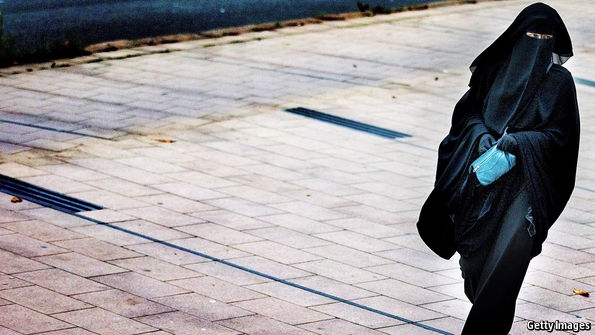
The four human forms that you see in this picture shrouded from head to toe in black fabric are supposed to be Muslim women dressed, as they see it in a shari’ah conforming attire. Talking to them will confirm that they are indeed women. I feel very confused, disturbed and distressed when I see such pictures. It gives my adorable Divine Deen a very ugly color. It looks funny and strange; defies all sense; hides the identity of my Sisters; puts unnecessary and harsh constraints and limitations on them and their movements; they are supposed to hear with their ears tightly covered; they will talk and eat with their mouths covered; yes they can breath but cover their noses. Allow me to vent out my feelings to you all; perhaps it may relieve me.

I am very clear on one issue. Those women who think that full body burqua are required by the Shari’ah they must do it, come what may and despite what I say. I admire their courage of conviction to wear it in a Western society with all its negative impact. But they have to realise that three fourth of the world population find this outfit very amusing. Even the great majority of Muslims think that Islam is too rational and meaningful religion to suggest such a uniform for women. I think if these four women were to forget for a moment that this is a shari’ah requirement and then look in the mirror they will probably be surprised at themselves. I will hasten to repeat, this type of burqua immediately becomes acceptable, desirable and respectable IF (and this is a mighty if ) it is a command from God Almighty; in that case logic gives in to obedience. 

What is the source in Islamic Law for this type of burqua/hijaab/purdah? This is not a forum to debate the correct interpretations  of the ayahs in Surah Noor and Ahzaab and the relevant ahaadith which are the sources usually quoted. Most traditional Ulema of the Madrasah Curriculum and Madrasah Philosophy of Taqleed (mandatory following of the Fiqh of the Four Schools of Sunni Islam of the ninth and tenth century) and specially the scholars of the Wahaabi-Saudi school strongly support a strict and rigid burqua. Independent thinking Islamic scholars notable among them the research scholar and academician Javed Ahmed Ghamdi have logically proved that these ayahs do not recommend any dress code for Muslim women. They have explained the relevant ayahs in their proper context and critically analysed the hadith literature to prove that our Shari’ah outlines in fact a very clear Code of Conduct for Islamic decency and modesty for both Men and Women. Moreover a vast majority of Muslim women all over the world have not adopted the full-body burqua seen in the photograph. An abaya with covering of the head is more common. A very significant number of sisters have metamorphosed the whole-body burqua into just a scarf on their head. It is very strongly promoted as “the hijab” since the mid nineteen seventies. It is touted as “the Muslim identity” or “flying the flag of faith” in our confrontations and conflicts with the West — our past colonizers  and present “enemies and killers of Muslims”. To the best of my knowledge, this last form of hijaab has no basis in our Shari’ah; it is more an outcome of social, cultural and political forces.

The four women in the photograph are at the Senate in The Hague during talks to ban full-body burqas in some public places in the Netherlands. Are they allowed to be there by the Shari’ah which they profess to follow? No; they are not. They are ignoring the main part of the shari’ah requirement. Based on the Quran (ayahs 30-31 in Surah Noor no. 24 and ayahs 32-33, 53 and 59 of Surah Ahzab no.33), the Sunnah and Hadith, all the Four Schools of Thought of traditional Sunni Islam have unanimously agreed that “hijaab” prescribes the following dress and code of conduct for Muslim women:
  1) Women to stay indoors; home is their workplace.
  2) Total segregation of genders at all levels and at all times; no mixed events at all.
  3) If a woman has to step out of her home out of necessity, she should be covered the way we see in the photograph. 

Please note: women are to stay and work indoors, always be in the company of women, no mixed events except with mehram males. Burqua is needed if and only when they are commuting for urgent reasons. These are the requirements of the shari’ah of their choice. 

If strictly followed, there should not be much of a problem for these women with the society they are living in. But these ladies have decided to follow their shari’ah half way. They will flout the shari’ah (which they have decided to follow) and participate fully in society and deal with men everywhere and anywhere but, in deference to their Shari’ah they will drag the  full-body burqua into the streets, conferences, hotels and music concerts etc; take half, leave the other half. Result? Aberration and anomaly; confusion and conflict. Instead of a sister you are dealing with a human shape and configuration which sounds to be a female.

Suggested take home message: If these four sisters are following an edict of Allah Ta’aala Subhanahoo to don this full-body burqua, hats off to them. We should all try and emulate them. If this is not a divine injunction and it is not, it just cannot be then this outfit is anything but Islamic, looks odd and perhaps ludicrous, denies any personality to our sisters and enforces undue restrictions on their movements and their social interactions with other human beings.

I came across and interesting piece on this subject “What not to Wear”  "What Not to Wear"
 in the International section of the Economist dated January 28th 2017. The subtitle reads “A dispute over Muslim women’s attire is helping nobody”. I would like to share with you some informative portions of the article.


It speaks of Aïcha Khobeizi seen in the photo who is presenting “an unusual sight on a university campus in strictly secular France dressed in her bottle-green nylon skirt and matching veil”. When she first decided to wear a headscarf, at the age of 15, her mother laughed and her father also disapproved. She persisted any how because “But I felt something was missing. I was determined to wear it in order to feel at ease with who I am.” Good luck, please go ahead I would say. But this does not make it Islamic. Our deen has tried to address the business of  modesty and decency; the sister has made it an issue of identity in her struggle and confrontation with her fellow citizens. She wants a prominent marker on her body to distinguish herself from her fellow citizens; a sort of self profiling. It does not bother her that, in the process she becomes an enigma to ninety nine percent of  folks around her.

About the present social and political climate in secular France the author says “there is a remarkable consensus for upholding curbs on religious dress from public place ……François Fillon, a front-runner, backed local bans on the “burkini”, a modest all-in-one swimsuit, last summer and considers the spread of the veil to be part of what he calls “Islamic totalitarianism”. The author adds “Last month Angela Merkel, Germany’s chancellor, told cheering members of her Christian Democratic party that exposing one’s features was part of normal interaction in a liberal society. Face covering, she said, should be banned “where legally possible”. He mentions a surprising piece of information “The strangest clampdown has occurred in Morocco. Earlier this month local officials told shopkeepers that the production, importation and sale of the burqa must end, and made them sign a document agreeing to the change.”

“Anxiety over Muslim dress is running high partly because of a surge in Muslim refugees ……and Islamist terrorist attacks in Belgium, France and Germany have stirred fears about immigrants” adds the author. I will strongly endorse when the author says “But there is a deeper cause. Secularist doctrine and Muslim culture are both evolving in a way that causes a clash over attire.” Put simply, the fight over the burqua and veil is not about religious phobias or racism. It is about culture and values, very highlighted in France. Muslim sisters would like to show the minimum part of their body. Western women, on the other hand  like to cover only the bare minimum required. The gulf is wide enough to cause friction in social interactions.

This debate is fast running away from law and shari’ah to personal opinions and individual freedom. As the article further says “In France, Quebec and even Turkey, a growing number of young Muslim women favour a live-and-let-live approach. “There’s no single meaning to the veil,” insists Ndèye Aminata Dia, a Senegalese-born woman working in Paris who has started a fashion line in stylish head-coverings. She wears her veil over a long flower-print skirt and carries a jaunty red handbag. “Wearing it doesn’t mean you are fundamentalist,” she says, “just as you can decide not to wear it, and still behave with modesty.” 

Some facts to correctly comprehend the real basis for this controversy over burqua according to the write-up: “Although Britons dislike mass immigration, they seldom get excited about Muslim dress. Nor do most Americans……..France is different. The roots of French political secularism, known as laïcité, go back to the revolution of 1789 and to an anti-clerical campaign in the early 20th century. By 1904 some 10,000 religious schools had been shut; thousands of priests fled France. “We have torn human conscience from the clutches of faith,” declared René Viviani, a Socialist minister. To France’s current Socialist government, with its strong attachment to laïcité , the row over the burkini was a rematch of 1905. Manuel Valls, then the prime minister and now a run-off candidate in the Socialist presidential primary, said the garment embodied the “enslavement of women”. Its logic, added the women’s minister, Laurence Rossignol, was “to hide women’s bodies in order better to control them”. Many citizens concur. Fully 72% say they would back outlawing the veil from university campuses, and 64% would ban the burkini from beaches.”

These facts also suggest that the root problem in this controversy is not Islamophobia or racism as much as deeply rooted social preferences and prejudices. Therefore to me as a Muslim, the crux of the problem  is to fall back on the source of our religion and find the correct verdict of our Shari’ah on this issue. If it prescribes burqua, we Muslims have no choice but to follow. However if it does not then Islam should not be dragged into the controversy. If some sisters feel a “sense of emancipation” or “knowing who I am” in burqua, please go ahead. Wish you good luck. But do not try to raise “a flag of Faith” above it. If you feel resistance from your fellow citizens, then deal with them without invoking Islam for it. The high sounding phrases usually thrown out such as “women emancipation” or “women enslavement” should be left to personal opinions. “Many educated young Muslim women consider themselves the beneficiaries of feminist battles fought by the previous generation. They have no time for arguments favored by academic feminists about whether the veil is a form of emancipation or oppression. Instead they insist on their right to dress how they like, whether in tight jeans or a full-length niqab, and not to be judged for it.”  I would like to add that the debate is and should be all about personal preferences, norms and rights, quite apart from religion or Islam.

When the government or state or establishment appears on the stage, the argument takes a different twist.  The article states: “From this perspective, the government’s attempts to impose and elaborate a dress code are not just an affront to their freedom but further proof of male chauvinism. ‘I am a feminist, I consider that I am equal to men and I wear what I want’ says Fatima El Ouasdi, a student in finance, who wears her skirt short and her hair loose and runs a women’s-rights group. ‘But the burkini ban really revolted me.’”
It adds “Yet the trend of “re-veiling” among young French women is sincerely regarded by many members of their mothers’ generation and by many politicians as part of a fundamentalist political project. They believe the government has both the right and the duty to oppose it. The French do not view the state merely as a provider of services but as a guarantor of norms. Lending legitimacy to certain individual choices is not just a matter of personal freedom but can have real social consequences.” To us Muslims, the phrase “guarantor of norms” should sound familiar and well come.

The article gives examples of the opposite trend i.e. to enforce the veil: “For evidence, some say, look at the banlieues (A suburb of a French city, especially an economically depressed suburb with a large immigrant population). The atmosphere in some heavily immigrant suburbs can curb freedom by making it hard not to wear the veil, argues Nadia Ould-Kaci, who co-runs a group called Women of Aubervilliers against the Veil. In recent years, she says, the spread of the veil in her district has reached “worrying” proportions. Girls of North African origin who do not wear it are insulted by being told that “God is ashamed of you.” The challenge is to defend women from such pressures while affirming individual freedom. “ Laïcité (French secularity; the French are very firm, sensitive and emotional about it) used to be about the neutrality of the state,” says Amélie Barras, a political scientist at York University in Canada. “But now it’s more about citizens, and what they can and cannot do.”

The last comment in the article explains the general approach of the folks towards this problem: social , cultural and political rather than religious: “One moderate in France’s presidential debate is Emmanuel Macron, a former Socialist minister. He argues that laïcité should not be “vindictive” and focused on prohibition. “I don’t think we need to invent new texts or new laws in order to chase the veil from universities,” he has said. Better to use other legal means of enforcing equality and women’s rights, such as child protection. Perhaps schools could take on the topic as part of civic education, and explain to girls that they can wear what they want within the law and do not have to dress how others tell them.” The author hastens to add “Such calm, nuanced thinking is rare. But France badly needs to work out how to marry secularism and liberty. If it cannot forge a more tolerant laïcité react, it runs the risk of estranging a generation of its own young Muslim women.”




A Gratifying Endorsement of One of the Islamic Values on Sex Morality in Modern America

A Gratifying Endorsement 
of
 One of the Islamic Values on Sex Morality in Modern America

It was really heartening to read an article Why It Matters That Pence Won’t Have Dinner With A Woman Who Isn’t His Wife in the Huffington Post of March 30, 2017 by Emma Gray. Not that our Islamic values need any approval from other sources. All the same it is a proof that ours is a Natural religion and builds on our natural God Given instincts.


Sex is a very strong appetite for all humans of all the genders. Unless society builds strong measures and barriers to harness it, this leads to widespread promiscuity, gender harassment and scandals: lots of them at all levels, high and low. I would call it a physiological phenomenon which is staring at us furiously in all modern “western” and fast intruding into “eastern” societies. The First, Effective and Bold step in this direction is the Golden Principle “ A man and woman should hate to be alone behind closed doors”. It builds a real and true family life, a unit of our society. I am really and pleasantly surprised to know that there are persons like our Vice President Mike Pence even in this openly and blatantly permissive society which he lives in. Hats off to him. The comments posted against this rule by the author and others are pure examples of ignorance. There have been numerous women as Prime Ministers, Presidents, Ambassadors, lawyers, doctors, CEO’s and successful business women in Countries that strictly follow this guideline. This is the first step to introduce some moral values in the present and prevalent amoral society fast descending into an abyss of immoral community. 

A Dissection of the Popular Buzzword "Leadership Skills/Qualities"

A Dissection of the Popular Buzzword "Leadership Skills/Qualities"

"Leadership Skills/Qualities" is the buzzword persistently dished out to our Youth in all circles and at all levels. What does it mean? Is it a  call for power and wealth? Is it a drive for status or a training for service? Is the captain of a soccer team, depending on strict team work as much a leader as the CEO of a corporation? Must a "leader" have a penchant and opportunity for authority and dominance as in politics and business or the front runners in other fields like science and arts should also be garlanded as "leaders". This insistence and craze for "leadership" has a great potential to dampen and deflect the efforts and personality of our adolescents. It prevents them from exploring their natural intuitions and inclinations which in fact are the basic drivers for getting ahead. History is full of glorious examples where individuals have achieved great heights in various fields by their personal ideas and skills; they did not aim for the spotlight which they ultimately received. This problem has been dealt with very efficiently, comprehensively and logically supported by facts by Susan Cain, author and founder of  Quiet Revolution in an article: Not Leadership Material? Good. The World Needs Followers. She has tried to prove that "The glorification of leadership skills, especially in college admissions, has emptied leadership of its meaning". I found it very informative and educational. See, what you make of it.

“Be Fair and Honest in Your Dealings with other Beings”, demands the Holy Quran from Muslims Surah Fatiha: Makki? Madni? Makki/Madni?

 “Be Fair and Honest in Your Dealings with other Beings”
 demands the Holy Quran from Muslims
Is Surah Fatiha: Makki? Madni? Makki and Madni?

ABSTRACT

The ayahs “And give full measure whenever you measure, and weigh with a balance that is true: this will be [for your own] good, and best in the end.”  and “WOE UNTO THOSE who give short measure: those who, when they are to receive their due from [other] people, demand that it be given in full but when they have to measure or weigh whatever they owe to others, give less than what is due! Do they not know that they are bound to be raised from the dead [and called to account] on an awesome Day, the Day when all men shall stand before the Sustainer of all the worlds?” are discussed. We are asked here to be  honest in our measurements and weights because of two reasons. Apparently, the ayahs are referring to rather small matters since we see a (physical) balance only in the grocery stores. It is in-fact referring to something much deeper and wider compatible with the dignity and level of the Holy Text. The rule is not restricted to weights and measures only but it includes all other means through which the rights of someone are evaluated, assessed or appraised. Sayyidna ‘Umar Ibn-ul-Khattab  saw a person curtailing [cutting short] his bowing and prostration postures in prayers, he said to him: “Lakhad Taffafta”ie. you have committed Takfif (curtailed the right) of Allah. It can therefore be logically surmised that these ayahs cover all forms of worship and rights of Allah like prayers, fasting, ablution, cleanliness etc.

Hopping from the religious to mundane, the injunction in these ayahs encompasses a wide variety of our dealings and activities between man and man; human rights in our modern jargon. One is required to evaluate (measure and weigh) honestly and properly the dues and rights of others and respond accordingly. A doctor must treat only what the patient needs and charge accordingly. Same goes for lawyers, be honest in assessing the problem of his client and bill him accordingly. Generally speaking we are told to give commensurate with what we have received and vice versa in all our dealings, transactions and business with others — commercial and non-commercial. As a proof of its importance, this message is repeatedly stressed in the Quran; six such ayahs are listed.

The Messenger of Islam is a historical figure and Islam and its teachings can be corroborated and verified.True but indeed there are also big and significant lacunae in our knowledge because of conflicting riwaayaah’.  The site of revelation of surahs — Makkah or Medinah — is a prominent example. Surah Mutaffafin as reported by Sayyida Ibn 'Abbss  is the first Surah that was revealed as soon as the Holy Prophet arrived at Madinah. On the other hand Sayyid Qutb, like many others thinks it is a Meccan Surah.The issue is further discussed

I was really shocked into disbelief when I read recently that even the Mother of Quran - Surah Fateha - is included in this controversy. Is it Makki-the majority opinion, Madni or Makki/Madni? This is elaborated in the text. A link to an article “Why Was Surat al-Fatiha Sent Twice?” by the popular and remarkable Muslim American scholar Sohaib Webb is attached and responded. I am completely baffled after reading it. It just flew past my head. At this moment I am glad I am not a scholar and do not approach my Deen by legal jargon. Nor do I regard riwaayaah as sacrosanct demanding Taqleed — blind following. As a sinner and PPK Muslim, Surah Fateha to me has to be an early Makki surah. (How early? I was trying to consult Maulana, Maulvi Mufti Google to find out when I came across this controversy) There is no way the early nascent community would be deprived of this valuable jewel for first twelve years of its existence, if this were to be a Madni surah. I also cannot conceive any reason to reveal it again in Madinah, as is argued by Sohaib Webb. First, the Muslims were already reciting it at least seventeen times daily in their mandatory prayers for a year or two before the migration to Madinah. Second, the beloved Messenger of Allah Ta’aala Subhanahoo was physically present amongst them to explain the additional meanings that this beautiful surah had acquired in Madinah.

March 25, 2017

 Read ONLY,  IF AND WHEN you have time and mood for: 
 “An Ayah of the Quran for 30 Days” -- March 2017

Choose the section you have time, in the next 30 days to read this ayah:-

Prelude:                       Recurrent Primary Message          1st.           Page
Starting Dua, a note & The Ayah                                      2nd.         Page
A Short Summary:       For the Busy Bee                           None        Pages
The Main Story:           Recommended                               Three       Pages
Footnotes:                   For the Perfectionist                        Two         Pages


PRELUDE
From the Pen and Perspective of a self-styled PPK Muslim (Proud, Practicing, Knowledgeable) with a humble submission that Islam totally rejects Blind Following BUT vigorously focusses on the Limitations of Pure Human Reasoning..............and clearly and comprehensively AlLAH knows best.

In the beginning of the seventh century C.E., the folks of Mecca and Medina had a fascinatingly unique window: they had direct access to the Heavens through one of their own. They were blessed with a regular stream of Divine counseling and guidelines. Question and answer sessions were part of the program. Even individual questioner was graced by an answer. In the short Introduction to this scheme they were assured that at the end of this twenty-two year project, Divine Directions and Admonitions will continue through the agency of the PEN. The whole discourse has been preserved and archived till eternity under the guarantee of our Lord and Creator. This record in known as the Quran. 

It should sound unbelievable but factually appears to be true: Many of our prevalent, widespread and important concepts and opinions about religious matters do not have a basis in the Quran and sometimes even appear to be in obvious conflict with the teachings of the Quran. It would be very educative and helpful to discuss an Ayah once a month to see if it supports or rejects our views and actions in our daily life. I wish and hope this email generates a fruitful interactive discussion. 

DUAA’
بِسمِ اللَّهِ الرَّحمٰنِ الرَّحيمِ


In the name of Allah, we praise HIM, seek HIS help and ask for HIS forgiveness. Whosoever Allah guideth none can misguide; whosoever HE allows to fall astray, none can guide him right. We bear witness that there is none worthy of worship but Allah alone and we bear witness that Mohammed, SAW is HIS slave-servant and the Seal of HIS Messengers. 
Further, we recall that Allah Ta’aala has declared in HIS Book1

 “He granteth wisdom to whom He pleaseth; and he to whom wisdom is granted receiveth indeed a benefit overflowing; but none will grasp the Message (or remember or receive admonition) but men of understanding (or intellect)”

 and we also recollect that he has warned us about the day of judgement2 

“Then on that day you shall most certainly be questioned about the boons (joy, pleasure).” 

We realise, that there cannot be a greater boon or blessing or benefit than wisdom and we wonder if this should be a timely reminder to very many of us sincere and practicing Muslims who use our critical thinking to enhance the mundane for ourselves and our families but resort to compulsory following -- taqleed, doctrine of classical Sunni Islamic Fiqh  -- in matters religion. 

(NOTE:  I have filtered out the proofs and details into the Footnotes for those who have the time and interest for them. The main email will then be reasonable length, hopefully for the busy majority. What follows is not a sermon; I do not feel qualified to give one, anyhow. I wish, it may provide a food for thought. A caveat seems in order: If the ayah selected pertains to issues we face in our daily life with our family, friends, neighbours or peers it may affect us personally and lead to some self analysis and soul searching which in turn could be divisive and distressing. If taken in the right spirit, it can be a humble attempt towards finding the “straight path”.) 

THE AYAH
Surah Al-Isra (no. 17), Ayah 35
وَأَوفُوا الكَيلَ إِذا كِلتُم وَزِنوا بِالقِسطاسِ المُستَقيمِ ۚ ذٰلِكَ خَيرٌ وَأَحسَنُ تَأويلًا
“And give full measure whenever you measure, and weigh with a balance that is true: this will be [for your own] good, and best in the end.” (Dr. Mohammad Asad)

A SHORT VERSION
None

THE MAIN STORY
“I am convinced about the veracity of my opinions, but I do consider it likely that they may turn out to be incorrect. Likewise, I am convinced about the incorrectness of the views different from mine, but I do concede the possibility that they may turn out to be correct.” Imam Shafa’i

This is the eleventh item in the “ten commandments of the Quran” that we have been discussing.  It is dealing with weights and measurement. This ayah (and the other that I will quote) is difficult to understand word for word because of the fluency of the Quranic Arabic. These ayahs are rhythmic and pleasant to the ears. However, translation in Urdu or English results in crude repetitions. We are asked here to be  honest in our measurements and weights because of two reasons:
First, it is good for us here in this world because it ensures mutual trust and confidence. It is intrinsically good. Rationally and naturally, no decent person likes to cheat others.
Second, it guarantees the best outcome in future; on the Day of Judgement only piety, honesty and taqwaa (fear of God) matters.
The same topic is addressed  emphatically in Surah Mutaffafin (also known as Surah Tatfif). According to some reports this is the first surah to be revealed after the Hijrah and refers to a very common practice in Medinah of those days. After this revelation this type of cheating came to a halt.3  

“WOE UNTO THOSE who give short measure: those who, when they are to receive their due from [other] people, demand that it be given in full but when they have to measure or weigh whatever they owe to others, give less than what is due! Do they not know that they are bound to be raised from the dead
[and called to account] on an awesome Day, the Day when all men shall stand before the Sustainer of all the worlds?”

Apparently, the ayahs are referring to rather small matters since we see a (physical) balance only in the grocery stores. The Holy text has no time for trivialities. It is in-fact referring to something much deeper and wider. It has used the word “mustaqeem” (straight) in the first ayah which always signifies a moral and spiritual connotation.“The word mutaffifin “those who give short measure or weight” in the second ayah is used in Arabic for an inferior and base thing and is derived from Tatfif “to give short measure or short weight” fraudulently. I like the way Mufti Mohammed Shafi has come to a broader meaning of these phrases compatible with the dignity and level of the Holy Text: “The Qur'an and Sunnah have prohibited Tatfif which primarily signifies 'giving short measure and weight', because generally all transactions are carried out by things that can be measured or weighed. But the basic purpose of weighing or measuring is none else but to give a person what he deserves. It, therefore, indicates that the rule is not restricted to weights and measures only, but it includes all other means through which the rights of someone are evaluated, assessed or appraised. It is obligatory that all rights are given to the deserving persons in full, whether they are assessed by weight, measure, number or any other means. In terms of this concept of Tatfif, it is prohibited to give to any person less than his due”. A riwaayah recorded in Muwatta of Imam Malik supports this logic:  Sayyidna ‘Umar Ibn-ul-Khattab  saw a person curtailing [cutting short] his bowing and prostration postures in prayers, he said to him: “Lakhad Taffafta” ie. you have committed Takfif (curtailed the right) of Allah. On the basis of this report Imam Malik has hypothesized: “le kulle shai’in wafaa’ wa tat’fif” ie everything has a full due and a short measure.

It can therefore be logically surmised that these ayahs cover all forms of worship and rights of Allah like prayers, fasting, ablution, cleanliness etc. We are expected to complete these duties fully and honestly. Cutting corners will amount to takfif indicating that we are giving short to our Lord Creator. 

Hopping from the religious to mundane, the injunction in these ayahs encompasses a wide variety of our dealings and activities between man and man; human rights in our modern jargon. One is required to evaluate (measure and weigh) honestly and properly the dues and rights of others and respond accordingly. An employee must honor the terms of his contract faithfully. The employer in turn must compensate fully for the services he has received. A doctor must treat only what the patient needs and charge accordingly. Same goes for lawyers, be honest in assessing the problem of his client and bill him accordingly. Generally speaking we are told to give commensurate with what we have received and vice versa in all our dealings, transactions and business with others — commercial and non-commercial; the “balance” mentioned in these ayahs is not just restricted to the grocery stores. This Divine prescription if followed in its true spirit can solve many of our social and economic problems.

“This instruction was not confined to individuals only” says Maulana Maudoodi “but it has been made a part of the duties of an Islamic Government to supervise transactions in the markets and streets to see that exact measures and weights are being observed, and prevent their breach and violation by the force of law. Afterwards it was made one of the duties of the government to eradicate dishonesty in all commercial dealings and economic transactions”. 

As a proof, if one is needed that Allah Ta'aala Subhaanahoo is conveying a very strong message in these two ayahs  —and not referring only to the physical balance in the grocery store — is the fact that criticism
of short measure and weight and encouragement of measuring fully and weighing rightly has been repeatedly stressed in the Quran apart from the two ayahs discussed earlier:

"You should use a full measure and a just balance. We charge one only with that much responsibility that one can bear.”4  
“Do not upset the balance: weigh with equity and do not give short weight.”5 

“……Give, therefore, full measure and weight [in all your dealings], and do not deprive people of what is rightfully theirs…….”6  

“And O my people! give just measure and weight, nor withhold from the people the things that are their due; commit not evil in the land with intent to do mischief.”7   

"[Always] give full measure, and be not among those who [unjustly] cause loss [to others] and [in all your dealings] weigh with a true balance”8     

It may be recalled that the people of Prophet Shu’aib were retributed because the majority persisted in measuring and weighing short despite repeated appeals and warning by their Prophet. 

We are all proud and rightly so that The Messenger of Islam is a historical figure and Islam and its teachings can be corroborated and verified. True but indeed there are also big and significant lacunae in our knowledge because of conflicting riwaayaah’.  The site of revelation of surahs — Makkah or Medinah — is a prominent example. Usually there are several opinions for the whole surah or conflicting reports for some of the ayahs. I have said earlier that Surah Mutaffafin is a Madni surah. It is also argued that these six ayahs which we have discussed are specifically directed towards people of Medinah of that time as this wrong practice of defrauding was very common in them when the Holy Prophet arrived. This is how Mufti Mohammed Shafi describes the situation:
“According to Sayyidna'Abdullah Ibn Mas'ud, Surah Tatfif was revealed in Makkah. Therefore, most of the copies of the Qur'an refer to it as the Makki Surah. According to Sayyidna Ibn 'Abbas, Qatadah, Muqatil and Dahhak, it is a Madani Surah, and only about eight verses are Makki. Imam Nasa'i transmits a narrative from Sayidna Ibn 'Abbas that when the Holy Prophet  arrived in Madinah, the people of Madinah whose most transactions were based on measurements used to cheat and short measure. For this reason, Allah revealed the Surah. It is reported from Sayyida Ibn 'Abbss  that this is the first Surah that was revealed as soon as the Holy Prophet arrived at Madinah. The reason is that it was a common practice in Madinah that the people used to be very strict in measuring when they had to receive something from others, but when they sold something, they used to cheat the buyers.  After the revelation of this Surah, all of them abandoned this bad custom totally, and mended themselves in a way that they are now well-known in their honesty in weighing and measuring. (Reported by  Hakim, Nasa'i, and Ibn
Majah, with sound chain of narrators)”

On the other hand Sayyid Qutb, like many others thinks it is a Meccan Surah. However he admits that the contents of these six ayahs are of Madni style. He then proceeds to explain the reasons for the revelation of this ayahs: “had to be revealed in Mecca because this practice of defrauding was very common in Meccans". Some confusion and contradiction is obvious in the two opinions.

It is now being discussed in scholarly circles that this practice of deciding the origin of a surah — makki or madni — on the basis of riwaayaah is misleading. The correct method suggested is to analyse the pattern, type and the nature of the contents  discussed. Entirely different issues are  addressed in the two periods because the fledgeling Ummah was passing through different phases. The tone and the tenor in Makki ayah is entirely different from the one revealed in Medinah. This basis is regarded as more reliable and has gained acceptance in the scholarly circles to decide the site of revelations.

Sayyid Qutb has some lucid and convincing comments on this problem and the anomalous position of these six ayahs. Perhaps you would like to read it: “Makkan sūrahs generally concentrate on the fundamentals, such as the assertion of God’s unity, the supremacy of His will and His dominion over the universe and mankind, and with assertions about the truth of revelation and prophethood, the truth of the Day of Judgement, reckoning and reward. The Makkan revelations also endeavour to form and develop the moral sense and relate it to the fundamentals of faith. The tackling of a specific issue of morality, such as the stinting of weights and measures, or business dealings in general, is a later concern; it is more characteristic of Madinan revelations, which regulate the life of the community in an Islamic state. The fact that this Makkan sūrah makes the issue of stinting its focal point therefore deserves careful consideration.”

I was really shocked into disbelief when I read recently that even the Mother of Quran - Surah Fateha - is included in this controversy. Is it Makki, Madni or Makki/Madni? According to Abd Allah ibn Abbas,  Qatadah and Abu'l-Aliyah, al-Fātiḥah is a Meccan sura; while according to Abu Hurayrah, Mujahid, 'Ata ibn Yasar and Az-Zuhri it is a Madinan sura. The former view is more widely accepted. This is also supported by the fact that the ayah 87 of Surah 15 "We have sent to you the Seven Oft Repeated Verses” was revealed in Makkah by agreement of the exegetes. There are some who believe that it was revealed in both Makka and Madina. Abu'l-Layth as-Samarqandi relates an extremely strange position that half of it was revealed in Makkah and the remaining half in Madinah as quoted from him by Al-Qurtubi. It is also said that this chapter was the first thing revealed of the Qur'an ( as against beginning verses of Surah Al-‘Alaq) as mentioned in the hadith reported by Al-Bayhaqi in 'Dala'il an-Nubuwwa'. Most narrators have agreed that al-Fātiḥah was the first complete Surah revealed to Muhammad. 

The popular and remarkable American Muslim scholar Suhaib Webb has discussed this issue in an article Why Was Surat al-Fatiha Sent Twice? 
http://www.virtualmosque.com/society/dawah/why-was-surat-al-fatiha-sent-twice/. I am completely baffled after reading it. How did you find it? It just flew past my head. For this moment I am glad I am not a scholar and do not approach my Deen by legal jargon. Nor do I regard riwaayaah as sacrosanct demanding Taqleed — blind following. As a sinner and PPK Muslim, Surah Fateha to me has to be an early Makki surah. (How early? I was trying to consult Maulana, Maulvi Mufti Google to find out when I came across this controversy) There is no way the early nascent community would be deprived of this valuable jewel for first twelve years of its existence, if this were to be a Madni surah. I also cannot conceive any reason to reveal it again in Madinah, as is argued by Sohaib Webb. First, the Muslims were already reciting it at least seventeen times daily in their mandatory prayers for a year or two before the migration to Madinah. Second, the beloved Messenger of Allah Ta’aala Subhanahoo was physically present amongst them to explain the additional meanings that this beautiful surah had acquired in Madinah.


........and Allah knows best.  
May Allah Ta’aala bless us with true understanding--“fahm”--of our Deen, Aameen.


FOOTNOTES

(1) Surah 2/269
يُؤتِي الحِكمَةَ مَن يَشاءُ ۚ وَمَن يُؤتَ الحِكمَةَ فَقَد أوتِيَ خَيرًا كَثيرًا ۗ وَما يَذَّكَّرُ إِلّا أُولُو الأَلبابِ


(2) Surah 102/8
ثُمَّ لَتُسأَلُنَّ يَومَئِذٍ عَنِ النَّعيمِ
(3) Surah 83/1-6
 وَيلٌ لِلمُطَفِّفينَ الَّذينَ إِذَا اكتالوا عَلَى النّاسِ يَستَوفونَ وَإِذا كالوهُم أَو وَزَنوهُم يُخسِرونَ
أَلا يَظُنُّ أُولٰئِكَ أَنَّهُم مَبعوثونَ لِيَومٍ عَظيمٍ يَومَ يَقومُ النّاسُ لِرَبِّ العالَمينَ
(4) Surah 6/152

وَأَوفُوا الكَيلَ وَالميزانَ بِالقِسطِ ۖ لا نُكَلِّفُ نَفسًا إِلّا وُسعَها
(5) Surah 55/8-9

أَلّا تَطغَوا فِي الميزانِ وَأَقيمُوا الوَزنَ بِالقِسطِ وَلا تُخسِرُوا الميزانَ
(6) Surah 7/85   (part of ayah)
فَأَوفُوا الكَيلَ وَالميزانَ وَلا تَبخَسُوا النّاسَ أَشياءَهُم……….
(7) Surah 11/85  
وَيا قَومِ أَوفُوا المِكيالَ وَالميزانَ بِالقِسطِ ۖ وَلا تَبخَسُوا النّاسَ أَشياءَهُم وَلا تَعثَوا فِي الأَرضِ مُفسِدينَ
(8) Surah 26/181-182

أَوفُوا الكَيلَ وَلا تَكونوا مِنَ المُخسِرينَ وَزِنوا بِالقِسطاسِ المُستَقيمِ

“Banning My Hijab Is Like Banning Me From Praying”; A Gross Exaggeration leading to Distortion of Islamic Shari”ah

“Banning My Hijab Is Like Banning Me From Praying”
A Gross Exaggeration leading to Distortion of Islamic Shari”ah

As per newspaper "The Guardian" of Tuesday March 14, the Court of Justice of European Union  says garments can be banned as part of general policy covering religious and political symbols. No wonder the news immediately trickled into the social media. Imam Asad Zaman shared a link from Aljazeera reporting in full the verdict of of the EU court. As expected, several opinions
were expressed. One of them "What the Hijab means to me"  quoted from Aljazeera of November 2016 is really interesting. It expresses the thoughts and feelings about the hijab of women from Nigeria to Uruguay. However, I am really concerned by an article "Banning MY Hijab is Like Banning Me From Prayer"  in the Huffington Post of March 14, 2017 by Basma Elbaz, Contributor, Editor-in-Chief & Blogger because it sounds as an exaggeration and distortion of Islamic Shari’ah. 
The writer starts with very balanced and mature statement: “It is absolutely fine to dislike hijab, to see it unnecessary or ugly. I will respect your opinion” followed by her objection: “But it is certainly a clear discrimination when you prevent me from wearing it”. More about it later. 

As a PPK Muslim I am greatly disturbed by her next statement: “This ruling makes it obvious that the court does not understand what hijab is for a Muslim woman. Wearing a hijab is not an accessory, it is part of the religion, and so banning it is like asking me not to pray”. This is an extremely misleading and ignorant reading of Shari’ah on hijaab. 

To start with, I would like to entreat all to keep our mandatory prayers completely out of this super-charged controversy over Hijaab. Prayers is our core and foremost duty since the days of Prophet Ibrahim, conveyed to us by a continuous chain. It is the most important of the Four Pillars of Islam; it is our cherished identity; it is the first item in our examination on the Day of Judgement. It serves as a unifying factor for the Ummah, allowing Muslims from the four corners to stand in one line, shoulder to shoulder on hearing the Azaan.  

The importance of hijaab does not come even close to it. Granted, it is a crucial part of our Eemaan. But can the writer tell me what is Shari’ Hijaab and what are its requirements? We see all sorts, style and color of “Hijaab” on the streets: a woman in short skirts and skinny jeans, in a form fitting maxi, in an elegant, attractive and colorful dress with dark read lipstick, in an outfit with shining embroidery and even a barbi doll turns into a “hijaabi” if she has a designer head covering —a muddled thinking.

As I have pointed out earlier the popular use of word “hijaab” is erroneous and misleading. What does the word hijaab means?
The Quran uses this word in Ayah 53 of Surah Ahzab (no. 33), as  meaning a “screen, curtain or shield”. 
The lexicon has two suggestions:
First, “the religious law that controls the clothes that Muslim women can wear”. Indeed the Classical Jurisprudence (Fiqh) of Sunni Islam describes in detail the requirements of hijaab.
Second, “the head covering that some Muslim women wear when they are outside”.Unfortunately, this is the popular usage of the word. But this new meaning has no basis in our Shari’ah which has a list of essentials for hijaab. (see below)

Based on the Quranic ayahs 30-31 in Surah Noor (no. 24) and ayahs 32-33, 53 and 59 of Surah Ahzab (no.33), the Sunnah and Hadith all the four schools of thought of traditional Sunni Islam have unanimously agreed that “hijaab” prescribes  the following dress and code of conduct for Muslim women:
  1) Women to stay indoors; home is their workplace
2) Total segregation of genders at all levels
3) If a woman has to step out of her home out of necessity, she should be covered in loose cloak as a sort of outer garment from head to foot (burqua, abaya) covering the neck also. Our Somali sisters in Minnesota provide a good example of this dress.
4) A veil on the face; compulsory by three schools; optional by Hanafia but recommended.

This has been the standard practice of hijaab in the Muslim world for centuries.In recent times, it started going through a process of amendment and modification mainly under the demands and needs of the universal changing pattern of life. It has been eroded part by part and step by step. I am not aware if any source in the Shari’ah supports these alterations.The final metamorphosis was seen in mid nineteen seventies when the “headscarf” alone irrespective of anything else became the sole objective and manifestation of dress code for Muslim sisters  and persistently referred to as “hijab”. This practice received a great momentum when the headscarf came to be regarded as “flying the flag of Faith”, a sort of Muslim identity in our confrontation with our previous colonizers and present “West”—“enemies and killers of Muslims”. This outlook was generously bank-rolled by petrodollars and ratcheted up by the Saudi-Wahabi propaganda machinery.

Headscarf alone as hijaab has NO basis in Shari’ah. If there is one, I would like to know. As a matter of fact, the way it is combined with a Western or Pakistani dress, or combined with an elegant style, adornment and decoration makes it look like a patchwork or a parody. Albeit, head-covering plus a plain black loose abaya blends smoothly and meets important requirements of the classical Islamic jurisprudence; and therefore is commendable. I admire the Somali sisters in Minnesota who have the courage of their conviction to wear it in a Western Society drawing a negative reaction. May Allah Ta'aala Subhaanahoo reward them for their efforts.

This is the version of the classical Sunni Islam about hijaab formed by consensus of the four Schools of Thought in the ninth century. However, the Islamic scholarly opinion has grown and developed in the meantime, despite the verdict of Taqleed clamped in the thirteen century to stifle Muslim intellectual growth. There are number of eminent scholars with huge following, notably the distinguished intellectual, researcher and academician Javed Ahmed Ghamdi who do not consider the above quoted ayahs in Surahs Noor and Ahzab as prescribing any particular dress code for Muslim women or men. A particular form or style of dress is not the business of Islam according to them. The prevalent suggestions about dress as Islamic are partly due to controversial interpretation of the relevant ayahs and traditions and partly based on historical, social and cultural background. This group of Ulemaa, maintains that the Shari’ah has focused on a strict code of conduct and has ordained clear do’s and don’ts for inter-gender social interaction. This is the Islamic prescription to prevent any indecency and promiscuity in Society and safe guard the institution of Family which is the back bone of an Islamic Society. 

While the “hijaabis” have full right  —and are admired for that — to don their attire and cover their head due to their religious beliefs, they are not justified to call it “Islamic”; this amounts to labelling as sinners those who do not agree with them and do not insist on covering the head. These are two different views and attitudes among Muslims on this issue due to varying interpretation of the relevant religious literature. Lets agree to disagree and keep up mutual discussions and deliberations to find the correct solution. 

One final point. The opposition to the headscarf itself is not all religious; it is not a good example of Islamophobia; it cannot be labelled as racism. It is more a play of culture and value system. The wearer of headscarf feels elated and proud that she is upholding the honor of her religion. She has the satisfaction of sacrificing for her religion; of flying the flag of Faith. But it is very and naturally provocative to the opposing group, those who do not believe in it, Muslims and non-Muslims; as if she is pointing a figure at them; publicly displaying her modesty. To them, it looks odd and out of place; rather prudish. Let me quote the opposite example to illustrate my point of view: there will be commotion and strong reaction if teenagers come out in their ultrashort shorts in the streets of Karachi, Jakarta or Kuala Lumpur or bikinis are displayed on the beaches of these cities. This is certainly not a sign of Christo-phobia. We, Muslims have very strong sentiments against exposing the female torso.The liberal West is exactly the opposite; they take pride in exhibiting the woman’s body; France takes the cake in this. “Marianne” is a national symbol of the French Republic and often considered as a symbol of a certain idea of Frenchness. The American historian Joan Wallach Scott wrote in 2016 that it is no accident that Marianne is often depicted as bare-breasted regardless of where she is or what she is doing, as this reflects the French ideal of a woman, which has been used as an argument for why Islamic dress for women is not French. He added that the topless Marianne has become "...the embodiment of emancipated French women in contrast to the veiled woman said to be subordinated by Islam”. In the same year the French Premier Manual Valls said In a speech: “Marianne has a naked breast because she is feeding the people! She is not veiled, because she is free! That is the republic!”. Hence making a big deal of covering the hair in their own country is very irritating to the West. Wrong, yes but Islamophobia, No.


There are many advantages touted for the headscarf, as the sole manifestation of hijaab. They all may be true. But this does not make it a requirement of the Shari’ah.