Search This Blog

Hijaab: The Shari'ah Version v/s the late Twentieth Century Variant

Hijaab: The Shari'ah Version
v/s
 The late Twentieth Century Variant

 Subject: Read ONLY,  IF AND WHEN you have time and mood for: 
 “An Ayah for 30 Days” -- September 2012


From the Pen and Perspective of a self-styled PPK Muslim (Proud, Practicing, Knowledgeable) with a humble submission that Islam totally rejects Blind Following BUT vigorously focusses on the Limitations of Pure Human Reasoning..............and clearly and comprehensively AlLAH knows best.

In the beginning of the seventh century C.E., the folks of Mecca and Medina had a fascinatingly unique window: they had direct access to the Heavens through one of their own. They were blessed with a regular stream of Divine counseling and guidelines. Question and answer sessions were part of the program. Even individual questioner was graced by an answer. In the short Introduction to this scheme they were assured that at the end of this twenty-two year project, Divine Directions and Admonitions will continue through the agency of the PEN. The whole discourse has been preserved and archived till eternity under the guarantee of our Lord and Creator. This record in known as the Quran. 

It should sound unbelievable but factually appears to be true: Many of our prevalent, widespread and important concepts and opinions about religious matters do not have a basis in the Quran and sometimes even appear to be in obvious conflict with the teachings of the Quran. It would be very educative and helpful to discuss an Ayah once a month to see if it supports or rejects our views and actions in our daily life. I wish and hope this email generates a fruitful interactive discussion. 


Continued from Previous in August


Surah 33 Ayah 53:
33:53


"O ye who believe! Enter not the Prophet's houses,-until leave is given you,- for a meal, (and then) not (so early as) to wait for its preparation: but when ye are invited, enter; and when ye have taken your meal, disperse, without seeking familiar talk. Such (behaviour) annoys the Prophet: he is ashamed to dismiss you, but Allah is not ashamed (to tell you) the truth. And when ye ask (his ladies) for anything ye want, ask them from before a screen: that makes for greater purity for your hearts and for theirs. Nor is it right for you that ye should annoy Allah's Messenger, or that ye should marry his widows after him at any time. Truly such a thing is in Allah's sight an enormity."  Yusuf Ali

As a continuation from the previous email of August 2012:

a) This is the ayah referred to as “the ayah of the veil”, or as the “descent of Hijab” and it heralded the drawing of curtains at the apartments of the wives of the Holy Prophet.  According to at least three authors (Karen Armstrong, Reza Aslan and Leila Ahmed), the stipulations of the hijab were originally meant only for Muhammad's wives, and were intended to maintain their inviolability. By instituting seclusion Prophet Muhammad, under instructions from his Lord was creating a distance between his wives and the perpetual thronging community on their doorstep. 

b) However as the Islamic Jurisprudence developed, the legal experts -- fuqahaa -- extended this hijab/curtain to mean division of the Muslim space into two i.e. total segregation of sexes.

c)The purpose of the concept of hijaab was to prevent sexual attraction and licentiousness leading to “fitnah” i.e. adultery and fornication.

d) To achieve these objectives: 
First, some dress codes are designed; it should be emphasized that the word hijab does not refer to any piece of cloth for women to wear. It refers to a concept and practice to implement the Shari’ah version of Modesty and Decency. 
Second, a certain type of behaviour and decorum has been proposed.

All the four schools of thought of Sunni Islam -- Hanafi, Maliki, Shafai, Hanbali -- are agreed on these
principles and have unanimously designed and advocated a scheme for Islamic Legal Hijaab and the injunctions related to them. Using the format of Maulana Mufti Mohammed Shafi in his classical Tafsir, Ma’aariful Quran the details of Sunni Shari’ah  on hijaab are briefly summarised (may sound stupid and arrogant, but much of this beats me):

  1. Hijaab of first degree: The real and desired objective of Shariah is Hijaab-ul-Ashkhas i.e. physical hiding of women from strangers. In other words, women and their movements should remain hidden from the sight of men. Allah Ta’aala says “ And stay quietly in your houses”(ayah 33/33) to the wives of the Prophet. Our scholars maintain that “ the verse means to impress that the woman's real sphere of activity is her home; she should carry out her functions within that sphere peacefully, and she should come out of the house only in case of a genuine need.”1     
2) Hijaab of second degree: If a woman has dire need to leave her house, she is required to cover her whole body from head to toes with a loose, flowing dress to cover the figure, gyrations and movements of the female body. The recommendation of the scholars include “the women should wrap themselves up well in their sheets, and should draw and let down a part of the sheet in front of the face and an eye, leaving only the other eye uncovered” and “to see their way, one eye can remain exposed or use a patch of net before the eyes” and “that she should walk on the side of the street and avoid the crowd.”2    

3) Hijaab of third degree: In this category the face is allowed to be exposed based on the opinion of Imam Abu Hanifa, who declared that face and hands are not part of satarul awrah of woman. However later scholars of the Hanafi school opined that exposing the face can in certain situation lead to fitnah. Hence their recommendations is to cover the face. A, fatwa by Muhammed Salih Al-Munajjid of  Saudi Arabia states: “The correct view as indicated by the evidence is that the woman's face is awrah which must be covered. It is the most tempting part of her body, because what people look at most is the face, so the face is the greatest 'awrah of a woman.” It may be added that the three Imams -- Malik, Shafa’i and Ibn Hanbal -- held it absolutely impermissible to expose face and palms. For practical purposes therefore, this third degree hijaab stands prohibited by consensus of the four Imams.

4) There are several other proscriptions and prohibitions in the Shari’ah Law of Hijaab:
a) Some jurists have declared that the voice of women is included in satr or awrah . However this issue is debatable in Fiqh.3    
b) Women should not wear perfume when they go out, as it is part of their zeenah.
c) Wearing decorated veil when going out is prohibited
d) One source has categorized the requirements of Hijaab as six heads.4
e)The issue of the Niqab has continued to arouse extended controversy and debate between `Ulama (scholars) and Fuqaha (jurists) both past and present concerning whether it is Wajib (mandatory) or Mustahab (favored by Allah) for the woman.5   

Despite the consensus of the Four Schools of Sunni Islam on the requirements of hijaab, on the ground, there is a wide spectrum in forms of hijaab seen in the Muslim communities round the world: 

The real orthodox and traditional are practicing full segregation and will don the full burqua which includes the face if they have to venture out due to unavoidable circumstances. 

The Taliban version adds coercion and cruelty in implementing Hijaab and is sweeping in its interpretation. 

There is a diluted version of orthodoxy who are soft on segregation, feel strongly about a full burqua showing only the eyes but feel free, contrary to the orthodox Shariah to go out on streets, bazaars, schools, colleges, offices even pop music concerts and dancing sessions. Some of them have migrated to the West causing issues in some European countries. Incidentally their migration is makrooh if not haram because the West is a very licentious and depraved society according to their value system.

The Saudi Arabian version has an elaborate State system, including a moral police to enforce their idea of  Hijaab.6   

Iran has it own version of Hijaab with the need for religious police to enforce compliance. After the Islamic revolution, Khomeini publicly announced his disapproval of mixing between the sexes.

The most interesting phenomenon is the twentieth Century Version of Hijaab observed, I guess in last three to four decades. Through a process of metamorphosis a simple and miniaturized version of hijaab has popped up: cover your head and hair with a scarf and that’s it; you are done. Covering rest of the body and the behavior and demeanor may be customised individually; no segregation of sexes; face left uncovered. Hence a wide variety of outfits are observed in practice. Quite presumptuously, the headscarf itself is marketed as “hijaab” which, as pointed out earlier is quite erroneous and misleading. If an Arabic word is preferred, the scarf can more accurately be called a khimar. 

As far as I can fathom this modern (and taken for granted in the English speaking Muslim world) version of Hijaab falls far short of the Sunni Shari’ah Law. It does not address the problem of Islamic modesty  and morality. Most probably this version of hijaab is based on cultural back ground and/or an inferiority/superiority complex and/or tribal affinities and/or religious self profiling and/or mindless herd mentality and/or geopolitical considerations. Here are a few observations as to why I think so:

(1) This version of hijaab certainly does not have any firm basis in Shari’ah, as enunciated by the consensus of the four school (mazaahib) of Sunni Muslim Islam, wherein overing hair is a small and probably insignificant part of Hijaab. I doubt if orthodox Islamic scholarship supports it. I am sure the Talibaan will prosecute this type of hijaabi woman. It is very unlikely to get by the moral police in Saudi Arabia or Iran. 

 (2) The ayah 24/31 on “khumur” is frequently coated as basis for this form of hijaab. However this conclusion is most probably based on an incorrect interpretation and incomplete application.7   

(3) The practice of covering the hair but leaving the face exposed does not make religious sense, let alone common sense. As far back as the seventh century, one of the eminent Companions Abdullah ibn Umer had the vision to decide that face is part of the zeenah of women which is included in the meaning of the ayah 24/31 ".....except what (must ordinarily) appear thereof....” and therefore face need not be covered. It is on the basis of this opinion that Imam Abu Hanifa decided, that face is not part of the awrah and can be exposed. The other three great Imams want the face to be covered. Should it not be apparent to the educated elite and PPK Muslims that the hair also should be included in the same exception in the twenty-first century as the face.8   

(4) A Muslim does not want his sister/wife/daughter to be an object of a meaningful gaze by another man.  If the man does it anyhow, who is at fault? It is the woman, it seems because Maulana Mufti Mohammed Shafi, a benchmark for Orthodox opinion declares that woman is the most lethal arsenal in the workshop of the Devil i.e. Shaitaan (as a young man I felt like blurting out to him: your mother may be an agent for the devil; mine is not). Hence the prescription by the authors of the prevailing Islamic Jurisprudence -- Fiqh/Shari’ah -- to wrap the woman up and put in a box. But this is plan B in Quranic Law reserved to protect women in special and selective adverse circumstances “.... that is most convenient, that they should be known (as such) and not molested...” ( verse 33/59). As a Primary and General rule for protection of women,  the Quranic Law has Plan A which suggests that to save embarrassment to your own women folk, you should stop gazing at the sister/wife/daughter of other men “Say to the believing men that they should lower their gaze....”(ayah 24/30). God Almighty has issued exactly similar injunctions to women as well: “And say to the believing women that they should lower their gaze.....”(ayah 24/31). No wonder, I love and adore my Deen: gave us golden rules in the seventh century which are valid in the twenty-first, provided we are prepared to think.  Woefully a Muslim today drives in the latest limousine guided by “GPS” to his/her office but hops on the camel and rides into the desert to see the moon by naked eye in matters of religion and it’s festivals. 

 (5) This version of hijaab ignores and misinterprets the essence and purpose of hijaab namely to ensure Islamic standards of modesty and decency in dress and behavior and thereby to avoid fitnah. A teenager with a tight skinny jeans with a short shirt displaying the anatomy and a headscarf on her head is regarded as “hijaabi.” Whereas another, wearing a smart shalwar kamees with nothing to reveal and a beautiful hair style will be considered as “non-hijaabi.”9   

(6) This form of hijaab has encouraged inconsistencies and contradictions. It is not uncommon to see a mother of three with a head scarf and her teenage girl accompanying her with a lovely hair style; the opposite also is occasionally true.  A woman covers her hairs diligently at one place and will show a lovely hair style at another. You can see teenagers proud of their head scarf in one gathering and happily running about wearing jeans, short shirt and fantastic hair style in another.10  

(7) The traditional Islamic literature usually frowns upon imitating other religions and Unbelievers (I personally, though do not see any problem wearing Western dress). It is therefore pertinent to note that this truncated version of Hijaab bears very close resemblance to the practice of Christian nuns.11 

(8) The why and how of this version of Hijaab remains speculative. I guess and it is only a guess that it has evolved as a symbol of our resistance to the West and as an icon of Muslim identity. This is wrong if not absurd.  A Muslim and Muslim Ummah do not need a trademark. The five mandatory prayers and the piety and personality that ought to go with is what defines and identifies a Muslim -- man or woman.12  

 In conclusion, a point for deliberation specially for us, in USA. Trying to meet the demands of Islamic dress code for modesty is probably the greatest cause of pressures and tensions on our delicate teenage daughters. Is asking them to frame their faces with veils on their heads like Christian nuns in the eyes of their peers worth this cost to them? Will it not be better, instead and worth this cost, if we can persuade, encourage and help our sweet smiling girls to avoid and dislike short shirts and fitting jeans and pants in search of Islamic decency?

.....and Allah knows best. 
May Allah Ta’aala bless us with true understanding--“fahm”--of our Deen, Aameen.


FOOTNOTES

(1) A hadith quoted on the authority of Hadrat 'Abdullah bin Mas`ud, states that the Holy Prophet said: The woman must remain veiled and concealed. When she comes out of her house, Satan stares at her. And she is closer to Allah's mercy when she is inside her house." All the activities, outside the house is not permissible to women in normal circumstances. I would like to emphasize that the segregation of the genders is the essence of Hijaab in the Shariah of Sunni Islam. Maulana Maudoodi has proclaimed: “As for purdah (hijaab) it is over and above satar which is meant to segregate women from non-mahram males.”

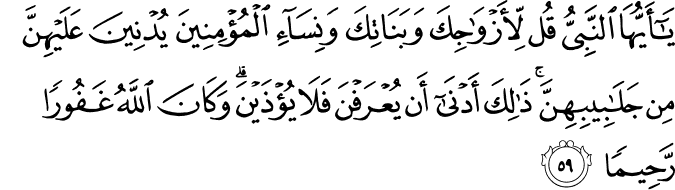
(2) The verse 33/59: 
33:59

O Prophet! Tell thy wives and daughters, and the believing women, that they should cast their outer garments over their persons (when abroad): that is most convenient, that they should be known (as such) and not molested. And Allah is Oft-Forgiving, Most Merciful” is the basis of this recommendation.  The word translated here as "outer garments" is jalabib, the plural of jilbab. But it does not necessarily refer to the present day garment known as jilbab. Translators usually represent the word jalabib with general terms like cloaks or outer garments; The two most common scholarly interpretations of jilbab are a travelling coat or cloak and a sheet-like full body garment similar to the modern jilbab. Some insist that the Qur'anic meaning of jilbab is identical to the present day garment. Others maintain that today's garment was developed as late as 1970 by the Muslim Brotherhood in Egypt. It has become tradition that Muslims in general, and Salifis in particular, believe the Qur'an demands women wear the garments known today as jilbāb and khumūr (the khumūr must be worn underneath the jilbāb). However, Qur'an translators and commentators translate the Arabic into English words with a general meaning, such as veils, head-coverings and shawls. 
The esteemed Quranic commentators At-Tabari, Al-Qurtubi, Ash-Shanqeeti and others have elaborated on the form of Hijab or Jilbab i.e., "outer garments" as viewed by the Companions of the Prophet, as well as the circumstances surrounding the revelation of this ayah. They state that when the believing women used to go out at night (wearing ordinary clothes) to answer the call of nature, some hypocrites tried to annoy them, thinking the women were slave girls. The women thereby would scream out loudly causing these hypocrites to flee. There upon Allah revealed this Ayah. Al-Qurtubi states that the Jilbab is "a cloth which covers the entire body.”; Ibn Abaas and Ubaidah As-Salmani have said “that it is to be fully wrapped around the women's body, so that nothing appears but one eye with which she can see." The Tabi'ee, Qatadah, stated that the Jilbab should be wrapped and fixed from above the forehead and made to cover the nose, (although the eyes are to show) and the chest and most of the face are to be covered.

Independent objective opinion does not support the views of these Scholars. 
“Muslim women remained in mixed company with men until the late sixth century (A.H.) or 11 th century (A.C.). They received guests, held meetings and went to wars to help their brothers and husbands, and they defended their castles and bastions”, according to Ibrahim B. Syed, Ph. D. President. Islamic Research Foundation International, Inc.
John Esposito professor of Islamic Studies at Georgetown University, writes that the customs of veiling and seclusion of women in early Islam were assimilated from the conquered Persian and Byzantine societies and then later on they were viewed as appropriate expressions of Quranic norms and values. The Qur'an does not stipulate veiling or seclusion; on the contrary, it tends to emphasize the participation of religious responsibility of both men and women in society. He claims  "in the midst of rapid social and economic change when traditional security and support systems are increasingly eroded and replaced by the state, hijab maintains that the state has failed to provide equal rights for men and women because the debate has been conducted within the Islamic framework, which provides women with equivalent rather than equal rights within the family."
Bloom and Blair also write that the Qur'an does not require women to wear veils; rather, it was a social habit picked up with the expansion of Islam. In fact, since it was impractical for working women to wear veils, "A veiled woman silently announced that her husband was rich enough to keep her idle."

(3) It has been ordained in the Quran (referred to earlier)  do not talk in a soft voice........ but speak in an unaffected manner (verse 33/32) and  "They should not stamp the ground in walking lest their hidden decoration is revealed."(verse 24/31). It is derived from these verses that the intention of the Lord clearly seems to be that the women should not attract other men by their voice or the jingle of their ornaments unnecessarily and if at all they have to speak to the other men, they should speak to them in an unaffected tone and manner. Similarly the Holy Prophet disapproved that feminine voices should enter the ears of men unnecessarily. In case of genuine need the Qur'an itself has allowed women to speak to men, and the Holy Prophet's wives themselves used to instruct people in religious matters. But where there is no necessity, nor any moral or religious objective, the women have been discouraged to let their voices be heard by men. Imam Shafa’i does not regard it as awrah. Many regard hearing of woman’s voice impermissible only if it may lead to fitnah. They think it is prudent, though to avoid talking to non-Mehrams; if inevitable then to avoid a soft and sweet tone. That is why it is forbidden for the woman to pronounce the call to the Prayer. Moreover, if a woman is attending a congregational Prayer and the Imam commits a mistake, she is not permitted to say Subhan-Allah like the males but should only tap her hands to call the imam's attention to the error.

(4) The First Requirement: The Extent of Covering
The Second Requirement: Thickness
The Third Requirement: Looseness
The Fourth Requirement: Color, Appearance and Demeanor
The Fifth Requirement: Difference from Men's Clothing
The Sixth Requirement: Difference from the Clothing of Unbelievers
The Seventh Requirement: No Vain or Ostentatious Dressing)))

(5) And whether she subsequently falls into sin by exposing her face or not. Each of the two sides clings to their own opinions which they support with evidences from the Quranic ayah, the Prophetic ahadith and the practice of the Sahabah and their views. One opinion allows the woman to expose and unveil her face as long as in doing so, she has not applied facial makeup.

(6)Women cannot drive. Sex segregation is prevalent in health centers. A male doctor is not allowed to treat a female patient, unless there are no female specialists available; and it is also not permissible for women to treat men. A woman is also not allowed to meet her spouse unveiled until after the wedding. Saudi daughters are encouraged to wear the niqaab in public. Religious Saudis believe it is forbidden for a woman to eat in public, as part of her face would be exposed, so in most restaurants barriers are present to conceal women. A rea; example of cruel interpretation: school girls, as they were running out of a burning school building were sent back forcefully for lack of head scarf.

(7)The translation of the relevant part of the ayah runs as “.........and let them wear their head-coverings over their bosoms......” The word khumur  (plural of khimar) here is referring to the head-covering customarily used by Arabian women in the period of Jahiliyah. According to most of the classical commentators, it was worn in pre-Islamic times more or less as an ornament and was let down loosely over the wearer's back; and since, according to the fashion prevalent at the time, the upper part of a woman's tunic had a wide opening in the front, her breasts were left bare. The Muslim women had continued this practice. The injunction - hukam -  in this ayah for the Muslim women is to cover their bosom, thus defining an important attribute of Islamic modesty and a sharp deviation from the practice of the kuffaar women. The women are advised to use the “khumar” -- which was the prevalent pre-Islamic female fashion -- for this purpose.  Javed Ghamidi, a traditional scholar but who lives and thinks in our century  argues that the word khumūr is mentioned in reference to the clothing of Arab women in the 7th century, but there is no command to actually wear them in any specific way. Hence he considers head-covering a preferable practice but not a directive of the shari’ah (law). Moreover scarves and veils of different colors and shapes were customary in countless cultures long before Islam came into being in the seventh century in the Arabian Peninsula (which includes present-day Saudi Arabia). To this day, head coverings play a significant role in many religions, including Orthodox Judaism and Catholicism.


(8) Is it not obvious that hair, head and face are just one contiguous part of human anatomy. The great Muslim poet, philosopher and scholar of Pakistan Allama Mohammed Iqbal suggests in his “Reconstruction of Religious Thought in Islam” that every generation of Muslims should rethink the issues and legislate according to their own needs. We Muslims endowed with intellect by Allah Ta’aala have used it to take full advantage of critical thinking, modern knowledge and technology to carve for ourselves and our families a prominent and profitable status even in Western societies. We owe it to our Creator therefore to use the same intellect and creative thinking to interpret Islamic injunctions and help our Deen to attain the status as the Religion of our Century. Islamic Jurisprudence must relate to the modern trends, style and sociological milieu. Does a doctor/dentist/lawyer need the same type of hijaab on a boulevard in New York with women running about in skimpy outfits need the same type of hijaab as a simple, innocent and illiterate housewife on the streets of tribal areas of Pakistan where the exposed knuckles of a woman is sufficient to arouse a man? On a personal note, my wife used to wrap a chador whenever she went shopping in Bohri Bazaar; she did not feel the need of it in Clifton. 

(9) Muslim women may/can/should look pretty and beautiful but not sexy; we  do/should want our sisters/wives/daughters to appear smart but not erotic. Hijaab is about concealing her sexuality but allowing her femininity to be brought out. The Arabic word At-Tabarruj (ayah 33/33), means not only "to display oneself" but also "to spruce up one's charms for the purpose of exciting desire"; this is what Muslim women are forbidden. Hairs do not have a particular sexual attraction to a man of normal sexual appetite. It is the body with its provocative size, shape, curves, gyrations and movements that makes a woman sexy and erotic.  A good hair style makes a woman pleasant and charming; this is acceptable. A curvaceous body with focus on gyrations makes her lewd; this is not acceptable. In our social gatherings, comments like “so and so has a pretty face, or she has beautiful hairs, her hair style was gorgeous, she looks attractive, she has a beautiful smile” should not and does not raise any eye brows. On the other hand slightest reference to the body as shapely etc will and should sound highly objectionable. The vigorously oscillating pony tail of a jogging woman just looks either funny or interesting. On the contrary depicting moving parts of body are favorite scenes in Indian movies to attract male attention. Once again a dance in such movies focusses on erotic movements of the body. As against this a clean classical dance concentrates on the face, hair style and graceful movements of head and arms. I cannot recall a single sensual (and therefore vulgar) scene in Hollywood/Bollywood movies where the hair of the heroine played any role.  Only an advertisement for cosmetics and hair products will display the hairs prominently. To sell a new limousine needs a female torso in bikini. In short, guarding modesty and decency needs a focus on the body; head and the hairstyle can safely be left alone. 

(10) Designer scarves with dazzling colour and beautiful designs are interestingly seen in weddings and expensive parties. A garment i.e. the headscarf which is intended to conceal a woman and her beauty from public view cannot be a thing which enhances her beauty. Therefore, the garment cannot contain bright colors, bold designs or shiny and reflective material that draw men's attention to the wearer. At a recent wedding, I saw a girl with a headscarf dancing in the balcony to the tune of rock music played on the stage. A scarf on the head but inadvertently ignoring to cover the bosom appears questionable. Working in an open mixed gym with smiles on an uncovered face will be forbidden under Shari’ah law; it is totally acceptable to PPK Muslims in our times specially in the West; however a headscarf does not blend in this scenario; it appears paradoxical.  In the corridors and courtyard of the Aga Khan Unviversity it was not uncommon to see girls with headscarves to socialize very informally with boys on one to one basis. Wearing a kamees with a high side slit or a fitting pant or a well stitched maxi dress is not uncommon in our parties; quite normal and do go unnoticed; however this practice stands out in sharp contrast if a headscarf is added; they appear contradictory. 

(11)This is a general ruling of the Shari'ah which encompasses not only dress but also such things as manners, customs, religious practices and festivities, transactions, etc. Indeed, dissimilarity with unbelievers is a precedent that was established by the first generation of Islam. The following two ahadith will help to clarify this position: 
Abdullah ibn Amr ibn Al-Aas said: Allah's Messenger saw me wearing two saffron-colored garments, so he said: Indeed, these are the clothes of kuffar (unbelievers), so do not wear them. [Sahih Muslim].
Abdullah ibn Umar said: Allah's Messenger stated: Whoever resembles a people is one of them [Abu Dawood].  
The Western media just loves the fact that this version of Hijaab bears very close resemblance to the practice of Christian nuns.  It does not let go any opportunity to display the “modern Muslim nuns” as a sign of the perceived “backwardness” of Muslim society; berating us, that we Muslims have now adopted the custom started by the Christian nuns two millennium ago and which now has been almost discarded by them. It is ever ready to screen women in headscarves as an example of Islam’s attitude of “women bashing and oppression.”

(12) The colonial experience and influence has big role to play in this context. French and British colonizers encouraged Muslim women to remove the veil and emulate European women. Consequently, in Algeria and other North African and Middle Eastern countries, the veil became a symbol of national identity and opposition to the West during independence and nationalist movements. It has probably become an issue of “they guys” against “us guys.” The headscarf is regarded as a symbol of female Muslim identity just as a long beard and white cap is for men. We Muslims want to look different. However we will not like it if we are treated as different! It could perhaps be the same sentiment which caused this practice in early Christianity -- to look unattractive to a male gaze. To quote an Iranian school girl "We want to stop men from treating us like sex objects as they have always done. We want them to ignore our appearance and to be attentive to our personalities and mind. We want them to take us seriously and treat us as equals and not just chase us around for our bodies and physical looks." Among Muslim women, the debate about headscarf which they label as hijaab takes many forms. Many believe that the veil is a way to secure personal liberty in a world that objectifies women. Several women have argued that hijaab allows them freedom of movement and control of their bodies. Understood in such terms, hijaab protects women from the male gaze  and allows them to become autonomous subjects. Others have argued that the veil only provides the illusion of protection and serves to absolve men of the responsibility for controlling their behavior. A Muslim woman who covers her head is making a statement about her identity. Anyone who sees her will know that she is a Muslim and has a good moral character. Many Muslim women who cover are filled with dignity and self esteem; they are pleased to be identified as a Muslim woman. In contrast, many daughters of Muslim immigrants in the West argue that the veil symbolizes devotion and piety and that veiling is their own choice. To them it is a question of religious identity and self-expression. On and on, goes the tale.    


Is it Correct to designate the Headscarf alone by itself as Hijaab of the Muslim Shari'ah?

Is it Correct
To designate the Headscarf alone by itself
As Hijaab of the Muslim Shari'ah?

 Read ONLY,  IF AND WHEN you have time and mood for: 
 “An Ayah for 30 Days” -- August  2012


From the Pen and Perspective of a self-styled PPK Muslim (Proud, Practicing, Knowledgeable) with a humble submission that Islam totally rejects Blind Following BUT vigorously focusses on the Limitations of Pure Human Reasoning..............and clearly and comprehensively AlLAH knows best.

In the beginning of the seventh century C.E., the folks of Mecca and Medina had a fascinatingly unique window: they had direct access to the Heavens through one of their own. They were blessed with a regular stream of Divine counseling and guidelines. Question and answer sessions were part of the program. Even individual questioner was graced by an answer. In the short Introduction to this scheme they were assured that at the end of this twenty-two year project, Divine Directions and Admonitions will continue through the agency of the PEN. The whole discourse has been preserved and archived till eternity under the guarantee of our Lord and Creator. This record in known as the Quran -- a book rooted in the daily life of the Prophet and his community and often a response to a given situation.

It should sound unbelievable but factually appears to be true: Many of our prevalent, widespread and important concepts and opinions about religious matters do not have a basis in the Quran and sometimes even appear to be in obvious conflict with the teachings of the Quran. It would be very educative and helpful to discuss an Ayah once a month to see if it supports or rejects our views and actions in our daily life. I wish and hope this email generates a fruitful interactive discussion. 

Surah Al-Ahzab (33) Ayah 53:
33:53


Yusuf Ali
O ye who believe! Enter not the Prophet's houses,-until leave is given you,- for a meal, (and then) not (so early as) to wait for its preparation: but when ye are invited, enter; and when ye have taken your meal, disperse, without seeking familiar talk. Such (behaviour) annoys the Prophet: he is ashamed to dismiss you, but Allah is not ashamed (to tell you) the truth. And when ye ask (his ladies) for anything ye want, ask them from before a screen: that makes for greater purity for your hearts and for theirs. Nor is it right for you that ye should annoy Allah's Messenger, or that ye should marry his widows after him at any time. Truly such a thing is in Allah's sight an enormity.

The mosque was the home and the home was the mosque. All the religious, civic and military affairs were conducted in this mosque/home complex. People -- rustic bedouins and the sophisticated -- were constantly coming in and out of this compound at all hours of the day. When delegations from other tribes came for their problems, they would set up their tents for days at a time inside the open courtyard just a few feet away from the apartments -- pigeonholes by present standards -- used by the inmates so much so that the sound of gargling inside would be heard in some parts of courtyard outside. New emigrants who arrived in Medinah would often stay within the mosque's walls until they could find suitable homes. This was the “White House” for the Last Prophet of God, the undisputed leader of the people, their Lawgiver and Legislator, their Judge and Councillor and their Commander-in-Chief. Be sure to fly back in time to early seventh century CE and visit this unique spot on the surface of the earth if you want to understand and comprehend what follows.

Comparatively a long ayah, it is conveying different messages (which have been color coded). It is of utmost importance to focus that the ayah is mainly and perhaps exclusively concerned with instructions for “ O you who believe” regarding the etiquette and manners for a visit to the family household of the Holy Prophet. 

To start with the bedouins are taught the elementary manners of entering, staying and leaving “ the Prophet’s houses.” Next the folks are reminded that the Rasool is too sophisticated to complain about it but he does gets annoyed because he is a human being with his feet on the ground as any body of us. 

Next follows the part of the ayah which has been labelled by the founders of religious knowledge as the First and probably the Central ayah for the institution of HIJAAB -- "the verse of the veil." The books of Fiqh always devote a chapter to the “descent of the hijaab”.The asbab al nuzul, ( the cause of revelation) critical to assess the meaning of this ayah is almost certainly the waleema at the wedding of Zainab bint Jahsh.1 The oft-repeated request by Umer ibn Khattab is another reason for nuzul cited by some authorities.2


The term hijaab used in this ayah is not referring to a veil or headscarf but is used in the context of a barrier or screen and is referring to the curtains that were hung at the doors of the apartments of the wives immediately after the nuzul of this ayah to guarantee the privacy of the wives. By instituting seclusion, Prophet Mohammed under instructions from Allah was creating a distance between his wives and the thronging community on their doorstep. Taken in historical context, this verse seems to have been primarily intended to give the Prophet's wives some protection against nuisance visitors and people who were looking for gossip about them. Gossip and slander were a great concern at the time the verses relating to hijab were revealed. The stipulations of the hijaab were meant only for Muhammad's wives, and were intended to maintain their inviolability. The term darabat al-hijab ("taking the veil"), was used synonymously and interchangeably with "becoming Prophet Muhammad's wife"; during Muhammad's life, no other Muslim woman wore the hijab. Later, muslim women started to wear the hijab to emulate Prophet Muhammad's wives, who are revered as "Mothers of the Believers" in Islam. The Qur'an, in this ayah instructs the male believers (Muslims) to talk to wives of Prophet Muhammad behind a hijaab -- the physical curtain on the doors of their apartments. This attitude of hiding and staying behind -- call it hijaab -- was the responsibility of the men and not the wives of Prophet Muhammad. 

However, in later Muslim societies this instruction, specific to the wives of Prophet Muhammad and specifically for their privacy, was generalized by the traditional exponents of Islamic Jurisprudence to all men and women at all times. Our ulemaa and fugahaa have extrapolated the “curtains” at the door of the First Ladies of Islam which descended immediately after this ayah to permanent “screens” between men and women thus creating a permanent division in the Muslim space and advocating segregation of genders as mandatory. Listen to Maulana Maudoodi, as an example.3 The only basis for this very intense and far reaching conclusion is the reference to “that makes for greater purity for your hearts and for theirs” at the end of this part of the ayah. Similarly Allah’s reference elsewhere in the Quran on this subject of hijaab namely:
“O Consorts of the Prophet! Ye are not like any of the (other) women: if ye do fear (Allah), be not too complacent of speech”4
“ And stay quietly in your houses and make not a dazzling display, like that of the former Times of Ignorance”5
“O Prophet! Tell thy wives and daughters, and the believing women, that they should cast their outer garments over their persons (when abroad)”6
  “that they should not display their beauty and ornaments except what (must ordinarily) appear thereof; that they should draw their veils over their bosoms...... and that they should not strike their feet in order to draw attention to their hidden ornaments.”7
seem to be interpreted out of context, ignoring the letter and spirit of the Quranic verses. The ayahs that speak volumes about the basis of Islamic hayah and sharam for both the genders namely “ Say to the believing men that they should lower their gaze”are hardly quoted let alone discussed in the context of hijaab. Hence it seems that the traditional teachings and recommendations in the Fiqh (jurisprudence) of Sunni Islam and labelled as the Shariah on the topic of Hijaab are controversial and probably not based on the letter and spirit of the Divine Book. An intense and extensive research on this subject by the PPK Muslims with the help of modern  Ulema and Fuqaha -- who are prepared to think out of the box -- is long over due. It cannot be over emphasized that Tabligh and Da’awa are one of the basic duties of the Muslims for the cause and propagation of Islam. It is also apparent that hijaab and all that goes with it is the main reason for the negative image of Islam as “woman bashing” in the whole non-Muslim world -- three-fourth of humanity and the main target for Da’awa. 

 The ayah then goes on to implore the Muslims not to annoy the Prophet. Why? Is it possible that a believer would dare to annoy the Prophet of Allah? Surprisingly yes, he did dare, definitely and repeatedly. These are the facts of life quite contrary to the image of respect and elation that we would like to build around Allah’s Rasool. An example of this is the fact that there were men who declared on the face of our prophet that they would marry his wives after his death. This is the incident that called for the last part of this ayah. 

There are seven ayahs in the Quran and more than seventy ahadith9 regarding the why and what of Hijaab. According to Islamic scholarship, hijaab is given the wider meaning of modesty, privacy, and morality; the meaning of hijaab has evolved over time. However, hijaab, has been interpreted in many different ways by Islamic scholars and Muslim communities. The modesty in Qur'an concerns both men's and women's  gaze, gait, garments and genitalia, though the focus of our ulema is always the woman. This is a concept in Islam and not merely a dress code; it should not be reduced to a piece of cloth for women when out on streets. It includes not only dress and covering the body, but methods of behavior before members of the same and/or opposite sex, promoting privacy for females and prohibiting loose intermingling between males and females, and thereby encouraging modesty, decency, chastity and above all, respect and worship of Allah.  Also the dress code does not refer to a style or fashion of the outfit -- this is left to the individual according to the time and place -- but to satisfy a certain need of Hayah and Sharam, translated as modesty and morality. The primary and probably the only goal of Hijaab is to avoid sexual attraction which can lead to sensuality and fornication commonly referred to as Fitnah. Our scholars have disallowed all practices that may or can possibly lead to fitnah even if in a given case it may not lead to one (i.e. fitnah). 

Veiling has been rapt in controversy throughout history. Today, the goal of Shari’a behind the institution of hijaab is completely lost. Instead, the veil -- albeit a truncated version -- stands as both a symbol of Islamic identity and resistance to Western ways, while in much of Western thinking, the veil has become the symbol of the Middle Eastern woman and oppression. Lastly the hijaab, it may be noted is not a uniquely Islamic convention; it predates Islam by centuries.10 Interestingly the veiling advised in the Bible is attributed to women’s inherent inferiority.

TO BE CONTINUED
HIJAAB -- The Shari’a version v/s Modern version


.....and Allah knows best. 

May Allah Ta’aala bless us with true understanding--“fahm”--of our Deen, Aameen.


FOOTNOTES: 

[1]  Al_Tabari, reports Anas Ibn Malik as saying:
The Prophet had wed Zaynab Bint Jahsh. I was charged with inviting people to the wedding supper. I carried out this charge. Many people came. They arrived in group, one after the other. They ate and then they departed. I said to the Prophet:
"Messenger of God, I invited so many people that I can't find anyone else to invite."
At a certain moment, the Prophet said: "End the meal." Zaynab was seated in a corner of the room. She was a woman of great beauty. All the guests departed except for three who seemed oblivious of their surroundings. They were still there in the room, chatting away. Annoyed, the Prophet left the room. He went to Aisha’s apartment. Upon seeing her, he greeted her, saying:
"Peace be unto you, member of the household."
"And peace be unto you, Prophet of Allah," responded A'isha to him. "How do you like your new Companion?"
He thus made the round of the apartments of his wives, who greeted him in the same manner as A'isha. Finally, he retraced his steps and came again to Zaynab's room. He saw that the three guests had still not departed. They were still there continuing to chat. The Prophet was an extremely polite and reserved man. He quickly left again and returned to A'isha’s apartment. I don't remember any more whether it was I or someone else who went to tell him that the three individuals had finally decided to leave. In any case, he came back to the nuptial chamber. He put one foot in the room and kept the other outside. It was in this position that he let fall a sitr [curtain] between himself and me, and the verse of the hijaab descended at that moment. 
 It will help to summarise the most salient facts in this account by al-Tabari :
1 While drawing the curtain, Anas tells us, the Prophet pronounced what was to become in the Koran verse 53 of Sura 33, which for the experts is "the verse of the hijab." They are the words that Anas heard murmured by the Prophet when he drew the sitr (curtain) between them _ words that were the message inspired by God in His Prophet in response to a situation in which Muhammad apparently did not know what to do nor how to act. We should remember that the Koran is a book rooted in the daily life of the Prophet and his community; it is often a response to a given situation.
2 The second fact to take note of is that the Prophet was celebrating his marriage to Zaynab Bint Jahsh.
3 He invited to this event nearly the whole Muslim community of Medina.
4 All partook of the wedding supper and departed, with the exception of three impolite men who continued to chat without concern for the Prophet's impatience and his desire to be alone with his new wife.
5 The Prophet, irritated, went out into the Courtyard, walked up and down, returned to the room, and left again to wait for the visitors to leave.
6 Upon their departure, Allah revealed the verse on the hijab to the Prophet.
7 The Prophet drew a sitr between himself and Anas, while reciting verse 53 of Sura 33.
Fatima Mernissi: The Veil and the Male Elite:

[2]  And as regards the veiling of women, I said 'O Allah's Apostle!  I wish you ordered your wives to cover themselves from the men because good and bad ones talk to them. So the verse of the veiling of the women was revealed" (Bukhari, v1, bk 8, sunnah 395).....

[3] Now whosoever has been blessed with understanding by Allah can himself see that the Book which forbids the men and women to talk to each other face to face and commands them to speak from behind a curtain because “this is a better way for the purity of your as well as their hearts," could not possibly permit that the men and women should freely meet in mixed gatherings, educational and democratic institutions and offices, because it did not affect the purity of the hearts in any way. Tafheem ul Quran.

 Surah 33/54
33:54

"Whether ye reveal anything or conceal it, verily Allah has full knowledge of all things". Yusuf Ali
[4]Surah 33/32
33:32
"O Consorts of the Prophet! Ye are not like any of the (other) women: if ye do fear (Allah), be not too complacent of speech, lest one in whose heart is a disease should be moved with desire: but speak ye a speech (that is) just". Yusuf Ali
[5] Surah 33/33
33:33
"And stay quietly in your houses, and make not a dazzling display, like that of the former Times of Ignorance; and establish regular Prayer, and give regular Charity; and obey Allah and His Messenger. And Allah only wishes to remove all abomination from you, ye members of the Family, and to make you pure and spotless".  Yusuf Ali
[6]Surah 33/59
33:59

"O Prophet! Tell thy wives and daughters, and the believing women, that they should cast their outer garments over their persons (when abroad): that is most convenient, that they should be known (as such) and not molested. And Allah is Oft-Forgiving, Most Merciful".  Yusuf Ali
[7]Surah 24/31
24:31
"And say to the believing women that they should lower their gaze and guard their modesty; that they should not display their beauty and ornaments except what (must ordinarily) appear thereof; that they should draw their veils over their bosoms and not display their beauty except to their husbands, their fathers, their husband's fathers, their sons, their husbands' sons, their brothers or their brothers' sons, or their sisters' sons, or their women, or the slaves whom their right hands possess, or male servants free of physical needs, or small children who have no sense of the shame of sex; and that they should not strike their feet in order to draw attention to their hidden ornaments. And O ye Believers! turn ye all together towards Allah, that ye may attain Bliss". Yusuf Ali
[8]  Surah 24/30
24:30

"Say to the believing men that they should lower their gaze and guard their modesty: that will make for greater purity for them: And Allah is well acquainted with all that they do".  Yusuf Ali
[9] Ma’aariful Quran, Maulana Mufti Mohammed Shafi

[10] The practice of veiling has a long history in the Judeo-Christian tradition. Catholic nuns engage in the practice, of course, and there are several references to the practice in both the Old and New Testaments (King James Version). Ironically, the representation of veiling in the Bible is much more problematic than those in the Qur'an or the Hadith, because the Judeo-Christian sources imply that women should be covered because of their inherent inferiority. Historically, the veiling of the face was practised by many cultures before Islam and scholars say the adoption of its practice by Muslims was part of fitting into the society. 

From the earliest records, veiling was a sign of status. An Assyrian legal text dating back to the thirteenth century B.C., forbade prostitutes from wearing the veil, restricting its use to "respectable" women.
Veiling took place in the Greco-Roman world and respectable Athenian women were known to be secluded. In pre-Islamic Iran and the Byzantine Empire veiling and seclusion also existed and appear to have been indicators for urban-upper-and middle-class women to show that their husbands could afford to “keep” them. Wealth aside, at the heart of the separation of the sexes is the notion of male honor. In Mediterranean societies, both Christian and Muslim, a man’s honor is directly connected with the purity of the women in his family. Therefore, female behavior is to be controlled in order to maintain male honor.

During Islam’s rise in the Middle Ages, the use of the veil and gender segregation was commonplace in the Christian Middle East and Mediterranean regions, but their influence on Islam was relatively minor in the lifetime of Muhammad. Muslims in their first century at first were relaxed about female dress. When the son of a prominent companion of the Prophet asked his wife Aisha bint Talha to veil her face, she answered, "Since the Almighty hath put on me the stamp of beauty, it is my wish that the public should view the beauty and thereby recognized His grace unto them. On no account, therefore, will I veil myself." As Islam reached other lands, regional practices, including the covering of the faces of women, were adopted by the early Muslims. Yet it was only in the second Islamic century that the face veil became common, first used among the powerful and rich as a status symbol.

 It was only well after Muhammad’s death that the veil became a commonplace item of clothing among Muslim upper-class women, who began to veil as a sign of status following the example of the Prophet’s wives. It is unknown how and exactly when these customs spread to the general Muslim population, but it would have been following the Muslim conquests of areas where veiling was prevalent, and when the Muslim State was attaining greater wealth.


Are the Food and Women of Ehle Kitaab (Jews and Christians) Halal in Muslim Shari'ah

Are the Food and Women of Ehle Kitaab (Jews and Christians)
 Halal in Muslim Shari'ah

  Read ONLY,  IF AND WHEN you have time and mood for: 
 “An Ayah for 30 Days” -- July 2012


From the Pen and Perspective of a self-styled PPK Muslim (Proud, Practicing, Knowledgeable) with a humble submission that Islam totally rejects Blind Following BUT vigorously focusses on the Limitations of Pure Human Reasoning..............and clearly and comprehensively AlLAH knows best.

In the beginning of the seventh century C.E., the folks of Mecca and Medina had a fascinatingly unique window: they had direct access to the Heavens through one of their own. They were blessed with a regular stream of Divine counseling and guidelines. Question and answer sessions were part of the program. Even individual questioner was graced by an answer. In the short Introduction to this scheme they were assured that at the end of this twenty-two year project, Divine Directions and Admonitions will continue through the agency of the PEN. The whole discourse has been preserved and archived till eternity under the guarantee of our Lord and Creator. This record in known as the Quran. 

It should sound unbelievable but factually appears to be true: Many of our prevalent, widespread and important concepts and opinions about religious matters do not have a basis in the Quran and sometimes even appear to be in obvious conflict with the teachings of the Quran. It would be very educative and helpful to discuss an Ayah once a month to see if it supports or rejects our views and actions in our daily life. I wish and hope this email generates a fruitful interactive discussion. 


Surah Al-Maeda (5), Ayah 5

ٱلْيَوْمَ أُحِلَّ لَكُمُ ٱلطَّيِّبَٰتُ ۖ وَطَعَامُ ٱلَّذِينَ أُوتُوا۟ ٱلْكِتَٰبَ حِلٌّۭ لَّكُمْ وَطَعَامُكُمْ حِلٌّۭ لَّهُمْ ۖ وَٱلْمُحْصَنَٰتُ مِنَ ٱلْمُؤْمِنَٰتِ وَٱلْمُحْصَنَٰتُ مِنَ ٱلَّذِينَ أُوتُوا۟ ٱلْكِتَٰبَ مِن قَبْلِكُمْ إِذَآ ءَاتَيْتُمُوهُنَّ أُجُورَهُنَّ مُحْصِنِينَ غَيْرَ مُسَٰفِحِينَ وَلَا مُتَّخِذِىٓ أَخْدَانٍۢ ۗ وَمَن يَكْفُرْ بِٱلْإِيمَٰنِ فَقَدْ حَبِطَ عَمَلُهُۥ وَهُوَ فِى ٱلْءَاخِرَةِ مِنَ ٱلْخَٰسِرِينَ

Abul Ala Maududi
This day all good things have been made lawful to you.   The food of the People of the Book is permitted to you, and your food is permitted to them.  And permitted to you are chaste women, be they either from among the believers or from among those who have received the Book before you,   provided you become their protectors in wedlock after paying them their bridal-due, rather than go around committing fornication and taking them as secret-companions. The work of he who refuses to follow the way of faith will go waste, and he will be among the utter losers in the Hereafter. 

I have colour coded different parts of the translation of this Ayah to highlight that five different yet similar messages are conveyed in the same ayah. 
The Ayah starts (blue) with declaring the default principle in Islam for all muaamlaat (i.e. mundane problems of life, as against (ibaadaat) that all good things are lawful; prove it to be bad to make it unlawful1

The second part (red) declares all the “food” of the people of the Book is lawful to you. By consensus this term refers to animal food i.e. zabeeha of the ahle kitab ; other foods like cereals and vegetables can be shared even with non-Muslims. So Allah Ta’aala has clearly declared to the Muslim community in Medina in early seventh century that they can socialize and eat and drink with their fellow citizens, Jews and Christians of the city state of Medina and share their  zabeeha. Fourteen hundred years later, in the globalized pleural world of twenty-first century we Muslims are loudly debating on this issue. 

Why?  Is there a room for different interpretations of this portion (red) of the ayah?  To answer this question, let us refer to Usul al-Tafsir, or the Principles of Qur’aanic Exegesis. The steps and the sequence that the exegete (mufassir) follows in his task of explaining the Qur’an are as follows:
1) Explanation of the Qur’an with the Qur’an itself.
2) Explanation of the Qur’an with the Sunnah.
3) Explanation of the Qur’an with the statements of the Companions RA.
4) Explanation of the Qur’an with the statements of the Tabi’?n.
5) Explanation of the Qur’an with the language.
6) Explanation of the Qur’an based on opinion and deliberation (al-Ra’i wal-Ijtihad).

Therefore it is often recommended to “Begin the tafsîr of the Qur'ân with the Qur'ân” or “The best tafsîr is the explanation of the Qur'ân by the Qur'ân” or “One part of the Qur’an explains the other.” The mufessareen are more of less unanimous that, to start with no interpretation of any ayah is acceptable which runs contrary to the clear and obvious meaning of the text of the Quran. To elaborate this point beyond any doubt, I have quoted hereunder additional six translations of this ayah to show that there is no difference of opinion amongst the scholars about the obvious meaning of this part of the ayah:
Sahih International
 ".......and the food of those who were given the Scripture is lawful for you and your food is lawful for them......." 

Muhsin Khan
"Made lawful to you this day are At-Tayyibat [all kinds of Halal (lawful) foods, which Allah has made lawful (meat of slaughtered eatable animals, etc., milk products, fats, vegetables and fruits, etc.). ....The food (slaughtered cattle, eatable animals, etc.) of the people of the Scripture (Jews and Christians) is lawful to you and yours is lawful to them....." 

Pickthall
"......The food of those who have received the Scripture is lawful for you, and your food is lawful for them......." 

Yusuf Ali
 "....The food of the People of the Book is lawful unto you and yours is lawful unto them......" 

Shakir
 "......and the food of those who have been given the Book is lawful for you and your food is lawful for them......"

Dr. Ghali
"......and the food of the ones to whom the Book was brought is lawful to you, and your food is made lawful to them.....". 

The next step, according to the rules mentioned above, is to browse the Qur’aan for any other instructions on the issue of zabeeha.  Allah Ta’aala has described in HIS Book a list of proscribed animals 2. Hence pork, for example cannot be accepted even from people of the Book.  We also read about the need for reciting Allah’s name and the need for slaughter else where in the Quran.3 These ayahs, however do not and cannot limit the clear cut permission given in the Ayah under discussion. 

Commenting on this Ayah, Shaikh Yousuf Al-Qaradawi,4 in his Book “The Lawful and the Prohibited in Islam” states:
“Since Allah did not prohibit it, the food of the Jews and the Christians is permitted to you on the basis of the original permissibility of things, and likewise you can share your food with them. Accordingly, you can eat the flesh of the animals they have slaughtered or hunted, and they can eat what you have slaughtered or hunted ........The application of the phrase, ‘the food of those who were given the Scripture,’ is general and includes their meats, produce, and other foods. All of these are halal for us excepting what is haram in itself, e.g., the flesh of a dead animal, pork, and flowing blood, as these are haram regardless of whether they are obtained from a Christian, a Jew or a Muslim......... Some others hold the opinion that the food of the People of the Book has been permitted to us by Allah, Who is aware of what they say when slaughtering an animal......we know that imported meats, such as chicken and canned beef, originating with the People of the Book are halal for us, even though the animal may have been killed by means of electric shock or the like. As long as they consider it lawful in their religion, it is halal for us.”
On the other hand, many of the traditional scholars5 are of the opinion that the other ayahs referred to earlier1 & 2 restrict the clear and obvious permission of Allah Ta’aala in this  ayah and therefore have concluded:-
“In the light of both verses, it is deduced and understood that the Zabiha of the Ahl al-Kitab is only permissible when the name of Allah was taken at the time of slaughtering the animal and the slaughtering itself done in the proper manner. As mentioned earlier, this condition of reciting the name of Allah is independently necessary”. The Hanafi and Hanbali schools seem to endorse this opinion.  On the other hand, it is usually related from Imam Shafa’e (RA) that the animal will be halal even if the name of Allah is not pronounced intentionally, and to recite the name of Allah is merely a Sunnah. Certain scholars, on the basis of a hadith on the authority of Ayesha6 have recommended that the name of Allah may be pronounced before eating the meat, in lieu.
One reason why this issue is so emotionally charged is that the significance of slaughter has been blown up out of all proportion. Considering certain ahadith, the issue of slaughtering animals is not regarded as normal and mundane issue, but elevated to an act of worship: “the slaughtering of animals holds a significant position in Shariah. The Prophet (Allah bless him & give him peace) counted the slaughtering of animals with praying Salat and facing the Qiblah. He considered it from those specific features of Islam, which distinguishes a Muslim from a non-Muslim and regarded it as one of the hallmarks of a true believer with which his life and wealth is protected”7

As a result detailed and elaborate rules and conditions for “Proper and Valid Slaughter -- dhabiha” have been laid down:
  • The slaughterer must be a Muslim or a person from Ahlul-Kitaab (Jew or a Christian) 
  • The slaughter must be done with a tool with a sharp edge and the animal must be killed by the sharpness and not by using force and most of the four veins (including the Jugular vein, according to some) must be cut to ensure that the blood and other impure elements (!) come out from their body as much as possible 
  • The slaughter be done in a way that was least painful and most merciful to the animal.
  • The entire Umma is agreed upon the place of the cut which is the throat and base of the neck. 
  • The name of Allah must be taken at the time of slaughtering.
  • All these conditions are necessary individually and separately. 
  • Failure to fulfill them will render the animal unlawful. 

Pertinently, here is what a Hanbali Scholar8 of Salafi school has to say:
 “It is not essential to ask about that which was slaughtered by a Muslim or a kitaabi, and how it
was slaughtered, and whether the name of Allah was mentioned over it or not. Rather that should not be done, because that is being obstinate in religious matters. The Prophet (peace and blessings of Allah be upon him) ate meat slaughtered by the Jews and did not ask questions. In Saheeh al-Bukhaari and elsewhere it is narrated from ‘Aa’ishah (may Allah be pleased with her) that some people said to the Prophet (peace and blessings of Allah be upon him): Some people bring meat to us, and we do not know whether they mentioned the name of Allaah over it or not. The Messenger of Allaah (peace and blessings of Allaah be upon him) said: “Mention the name of Allaah over it and eat.” 

Before I move on to the other parts of this ayah, let me quote two more opinions as this is a matter that affects all of us all the time:

“If a Muslim or a kitaabi (Jew or Christian) slaughters an animal for meat, and it is not known whether he mentioned the name of Allaah over it or not, it is permissible to eat from it, and the one who eats it should say the name of Allaah because of the report that was narrated by al-Bukhaari (2057) from ‘Aa’ishah (may Allaah be pleased with her)......”.9  

“With regard to other types of meat, if the companies or individuals who produce meat are people of the Book, Jews or Christians, and it is not known from them that they kill the animal by electric shock, strangling or striking it on the head, as is well known in the West, then this meat is halaal.....”.10  

Moving to the next part of the Ayah (brown), Allah Ta’aala has categorically granted permission in plain terms to marry chaste women from Muslim and Kitabis. Again here the scholars have found reasons to qualify the clear permission of God, the Almighty. Imam Abu Hanifa regards it as permissible but makrooh. Ibn Abbas, forbids it for residents of all non-Muslim countries.  The Hanafis regard this practice as undesirable though lawful. Thankfully, Hasan Basri does not stipulate any such restrictions, stating that it is a general permission.  It is often emphasized as a condition to marry a Kitabi woman that she should be a chaste woman; it sounds strange as this condition of chastity is applicable for a Muslim woman as well. Lastly Imam Shafai regards “chaste” women to mean free women as against slave girls11! I know it is very impertinent of me if not madness to challenge the opinion of our great Imams and eminent Muslim scholars even though I have got Hasan Basri to support me. However, under the influence of the teachings of these titans of our Deen, I dare say, that any human being be it a renowned Imam, an esteemed Saint or a distinguished scholar is not qualified to modify, limit or restrict the clear and obvious commandments of our Creator, the Lord of the Worlds, The Beneficent, the Merciful,  the Master of the Day of Judgment. This is the central core of our Eemaan and Eitiqaad (Faith and Belief) and a debate on this issue may hover dangerously close to the frontiers of Kufr (Rejection). May God All Mighty forgive me for my audacity, if I am wrong.

We are then reminded, further down the ayah (purple) that the basic tenants of the idea of marriage in Islam are to be followed with the Kitabis also: take them in wedlock, not fornication nor as secret paramours. 

Lastly we are reminded (as is the pattern through out in the Holy Book) of our Faith and Belief in the Hereafter as the only sanction behind Allah’s commandments in this world; there is no human agency to arrest, indict and prosecute you for disobeying HIS commandments: The work of he who refuses to follow the way of faith will go waste, and he will be among the utter losers in the Hereafter. 

A short last note, as the closing remark so to say: I am a great admirer of Maulana Maudoodi. I regard his Tafheem as a remarkable and outstanding contribution to the science of Tafseer. With his mastery over Urdu language, he has meticulously explained our Holy Book to us in simple and self-explicatory and yet beautiful style. However I cannot help protesting on his last comment on this ayah. I think (and I hope I am not being rude to the great scholar) it betrays an ignorance of the dynamics of interfaith marriages, at least in our times and displays a definite hint of ta’assub and asbiyat -- prejudice and bias -- against the Ehle Kitaab, who are  our compatriots as in  Malaysia, Nigeria, Pakistan etc. and especially if we have migrated to their country as in US, Canada and Europe. Maulana has commented thus: 
  “The warning that immediately follows the permission given to marry women from among the People of the Book is very significant. The Muslim who makes use of this permission has been warned to guard his faith and morality very cautiously against the influence of his unbelieving wife. There is a genuine danger that his deep love might tender him a prey to wrong creeds and acts of his unbelieving wife and he might lose both his Faith and morality, or he might adopt a wrong moral and social attitude which might be against the spirit of his faith”.  

Compare this with Dr. Mohammed Asad’s comment in the same context:
“The above passage rounds off, as it were, the opening sentences of this surah, ‘O you who have attained to faith, be true to your covenants’ - of which belief in God and the acceptance of His commandments are the foremost. It is immediately followed (in the next ayah 6) by a reference to prayer: for it is in prayer that man's dependence on God finds its most conscious and deliberate expression.”

.....and Allah knows best. 
May Allah Ta’aala bless us with true understanding--“fahm--of our Deen, Aameen.


ENDNOTES: 
1) As against this, the default rule for ibaadaat is exactly the opposite: all forms and styles of worship are bida’a (innovation) unless proposed in the Qur’aan or the practice and preachings of the Holy Prophet.

2) Surah Al-Maeda (5), Ayah 3
5:3

Forbidden to you (for food) are: dead meat, blood, the flesh of swine, and that on which hath been invoked the name of other than Allah; that which hath been killed by strangling, or by a violent blow, or by a headlong fall, or by being gored to death; that which hath been (partly) eaten by a wild animal; unless ye are able to slaughter it (in due form); that which is sacrificed on stone (altars); (forbidden) also is the division (of meat) by raffling with arrows: that is impiety. This day have those who reject faith given up all hope of your religion: yet fear them not but fear Me. This day have I perfected your religion for you, completed My favour upon you, and have chosen for you Islam as your religion. But if any is forced by hunger, with no inclination to transgression, Allah is indeed Oft-forgiving, Most Merciful. (Yousuf Ali)
5:4
They ask thee what is lawful to them (as food). Say: lawful unto you are (all) things good and pure: and what ye have taught your trained hunting animals (to catch) in the manner directed to you by Allah: eat what they catch for you, but pronounce the name of Allah over it: and fear Allah; for Allah is swift in taking account. (Yusuf Ali)

3) Surah 6, Ayah 118 to 121
6:118
So eat of (meats) on which Allah's name hath been pronounced, if ye have faith in His signs.
Yusuf Ali
6:119
Why should ye not eat of (meats) on which Allah's name hath been pronounced, when He hath explained to you in detail what is forbidden to you - except under compulsion of necessity? But many do mislead (men) by their appetites unchecked by knowledge. Thy Lord knoweth best those who transgress.  Yusuf Ali
6:120
Eschew all sin, open or secret: those who earn sin will get due recompense for their "earnings."
Yusuf Ali
6:121
Eat not of (meats) on which Allah's name hath not been pronounced: That would be impiety. But the evil ones ever inspire their friends to contend with you if ye were to obey them, ye would indeed be Pagans. Yousuf Ali

Note: Surah 2, Ayah 173 has not been referred to but is quite relevant:
2:173
He hath only forbidden you dead meat, and blood, and the flesh of swine, and that on which any other name hath been invoked besides that of Allah. But if one is forced by necessity, without wilful disobedience, nor transgressing due limits,- then is he guiltless. For Allah is Oft-forgiving Most Merciful. Yusuf Ali

4) Yusuf al-Qaradawi (born 9 September 1926) is an Egyptian Islamic theologian. He is best known for his program, ash-Shariah wal-Hayat ("Shariah and Life"), broadcast on Al Jazeera, which has an estimated audience of 60 million worldwide. He is also well known for IslamOnline, a popular website he helped found in 1997 and for which he now serves as chief religious scholar. He has published more than 120 books, including The Lawful and the Prohibited in Islam. He has also received eight international prizes for his contributions to Islamic scholarship and is considered one of the most influential such scholars living today. Some of al-Qaradawi's views have been controversial in the West: he was refused an entry visa to the United Kingdom in 2008. As of 2004, al-Qaradawi was a trustee of the Oxford Centre for Islamic Studies.

5) I am referring to the very large group of Islamic Scholars who very aggressively pursue and propagate the principle of Taqleed, which could be labelled as “blind following”. They maintain that the Islamic Jurisprudence (Fiqh) has been defined, organized and totally completed as the Four Mazaahib by the end of fourth century A.H. Since then, according to this outlook there is no room for any independent and innovative approach to problems of Fiqh by later scholars. Ijtehaad i.e. thinking and reasoning -- very essential to solve the ever growing new and novel problems over the centuries -- is restricted only to qiyaas i.e. deductive analogy. Muslims are advised to blindly follow our brilliant ulemas of the tenth and eleventh century for the problems of the twenty-first century.  Allow me to mention an interesting example to illustrate the anomaly and oddity of this approach: namaz-e-kasr is valid if the journey exceeds three manzil; each manzil is the distance which an individual will cover when he starts traveling after the fajr prayers and continues till noon. How much distance will he cover before starting to shorten his prayers? About 45 miles as worked out by our fuqahaa.  Hence the popular fatwa for our century on the principle of Taqleed: pray kasr after a journey of 45 miles. It is immaterial for the traditional Muslim scholars that this will take a little more than an hour in a car and a few minutes in the plane. Difference of riding a camel in the desert under the hot sun for three days as against traveling in an air-conditioned car for an hour does not come in the equation at all because that needs thinking which is a forbidden fruit according to our traditional ule’maas.

6) Narrated 'Aisha (RA):  A group of people said to the Prophet (Sallaho Alaihe Wassallam), "Some people bring us meat and we do not know whether they have mentioned Allah's Name or not on slaughtering the animal." He said, "Mention Allah's Name on it and eat." [Bukhari] A dissenting note states: the application of meat slaughtered by new Muslims living on the outskirts of Madina to meat available in the western supermarkets where the religious affiliation of slaughterer is unknown is nothing but a fallacy!

7) Muhammad ibn Adam, Darul Iftaa, Leicester, UK.
8) Sheikh Abu 'Abd Allah Muhammad ibn Saalih ibn Muhammad ibn al-Uthaymeen at-Tamimi 1925 – 2001) was one of the most prominent Sunni Islamic scholars of the latter half of the twentieth century. Born in Saudi Arabia, he memorised the Qur'an at an early age and studied under well known scholars of the time including: Abd ar-Rahman as-Saa'di, Muhammad Ash-Shanqeeti, and 'Abd al-'Aziz ibn Baaz. During his many years of study, he became renowned for his knowledge in fiqh, eventually compiling over fifty books on the subject.

9) Sheikh Muhammed Salih Al-Munajjid, a known Islamic lecturer and author.

10)  al-Shaykh al-‘Allāmah, ‘Abd al-Rahmān b. Nāsir b. Barrāk b. Ibrāhīm al Barrāk. 
      Dept. of Theology and Contemporary Ideologies, College of Usūl al-Dīn, Riyadh, 
      Saudi Arabia

11) Tafheemul Quran, Maulana Maudoodi